There are around 40 recognized living dolphin species, and sorting through them can be surprisingly complex. Types of dolphins range from the familiar bottlenose dolphin found in warm coastal waters to the nearly extinct baiji of China’s Yangtze River, and each species occupies a distinct ecological niche. Dolphins are marine mammals belonging to the order Cetacea, parvorder Odontoceti, meaning they are toothed whales, not fish.
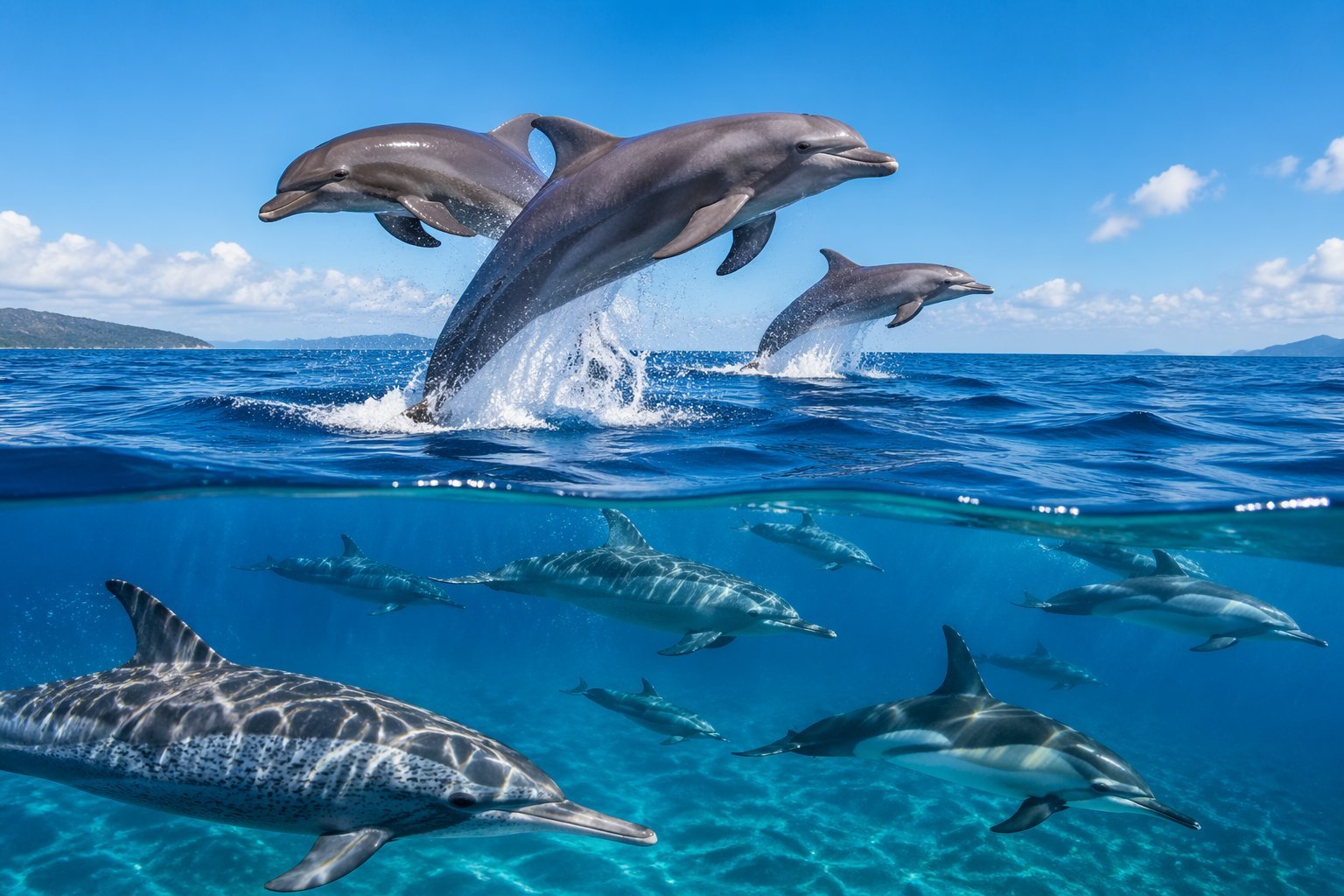
The key to making sense of dolphin diversity is understanding that the word “dolphin” covers multiple families, not a single group, and that several animals commonly called whales, including the orca, are technically dolphins. River dolphins and oceanic dolphins split into separate lineages long ago, look quite different from one another, and face very different conservation pressures.
This guide works through dolphin classification, covers well-known and lesser-known species, explains how to tell dolphins apart from porpoises and mahi-mahi, and highlights the species facing the greatest extinction risk.
Key Takeaways
- Dolphins belong to several distinct families within the toothed whale group, with oceanic and river dolphins being the two broadest divisions.
- The orca is the largest member of the dolphin family, and several other “whales” are actually classified as dolphins.
- Some dolphin species are critically endangered, while others remain widespread and relatively abundant.
How Dolphins Are Classified
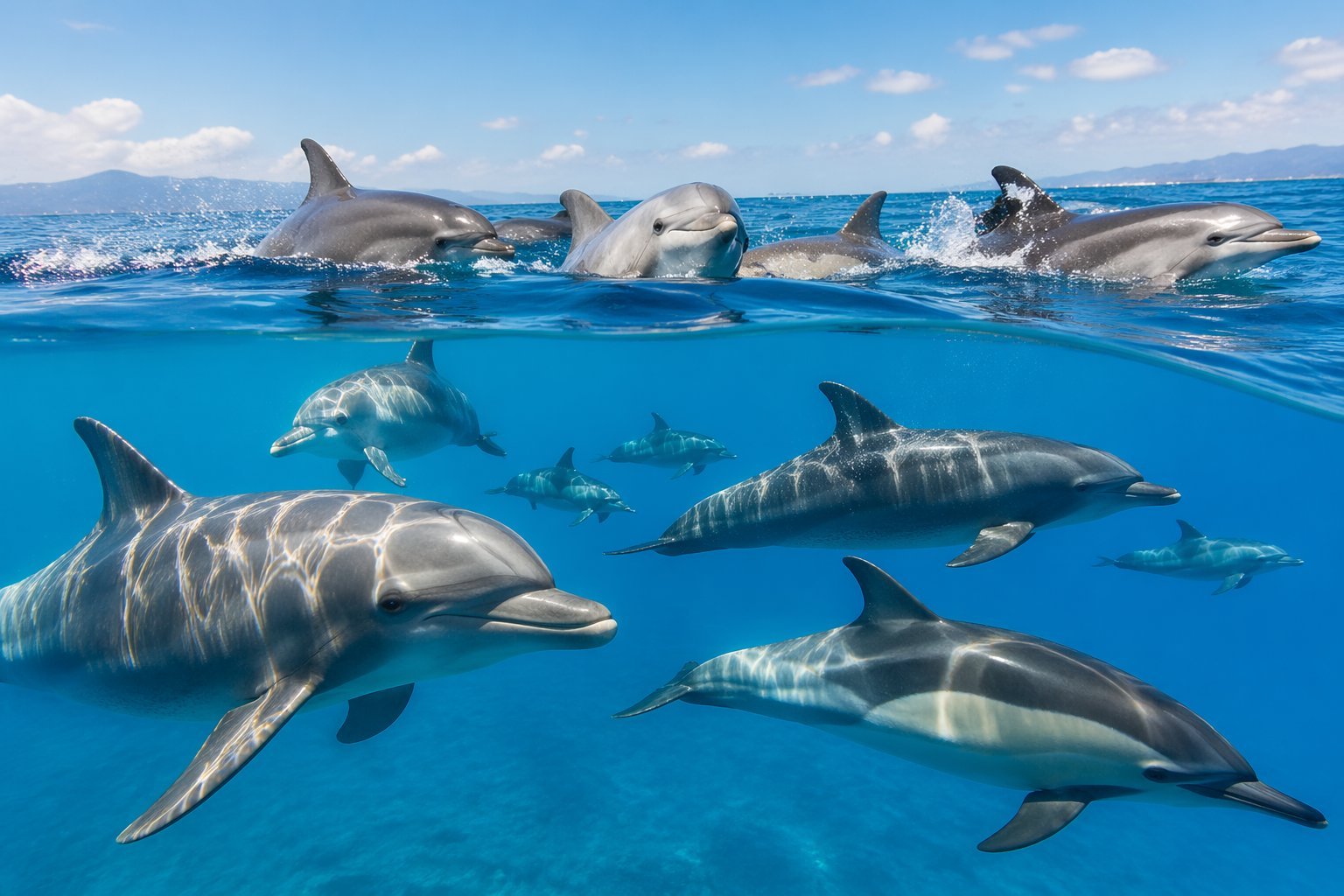
Dolphins sit within the parvorder Odontoceti, the toothed whales, which itself falls under the infraorder Cetacea. They are not a single taxonomic family but rather a loose grouping across five families, separated broadly into oceanic dolphins and river dolphins.
Oceanic Dolphins and the Delphinidae Family
The family Delphinidae is by far the largest dolphin family. It contains the majority of dolphin species you are likely to encounter, including bottlenose dolphins, spinner dolphins, orcas, and pilot whales.
Delphinidae species are found in oceans worldwide, from tropical shallows to cold polar seas. The family also includes several animals commonly called whales, such as the orca and the pilot whale, both of which are scientifically classified as dolphins.
River Dolphins and Freshwater Lineages
River dolphins belong to separate families from oceanic dolphins. The primary river dolphin families are:
- Platanistidae: South Asian river dolphins (Ganges and Indus)
- Iniidae: New World river dolphins, including the Amazon river dolphin
- Pontoporiidae: The franciscana, a nearshore brackish-water specialist
- Lipotidae: The baiji, now almost certainly extinct
River dolphins tend to have longer, narrower beaks, smaller eyes, and more flexible necks than their oceanic relatives, adaptations for navigating murky, shallow freshwater environments.
How Many Living Species Are Recognized
The current count of living dolphin species sits at approximately 40, though taxonomic revisions occasionally shift that number. Splitting species, such as the common dolphin into short-beaked and long-beaked forms, can raise the total, while new genetic analysis sometimes merges previously separate species.
Well-Known Ocean Species
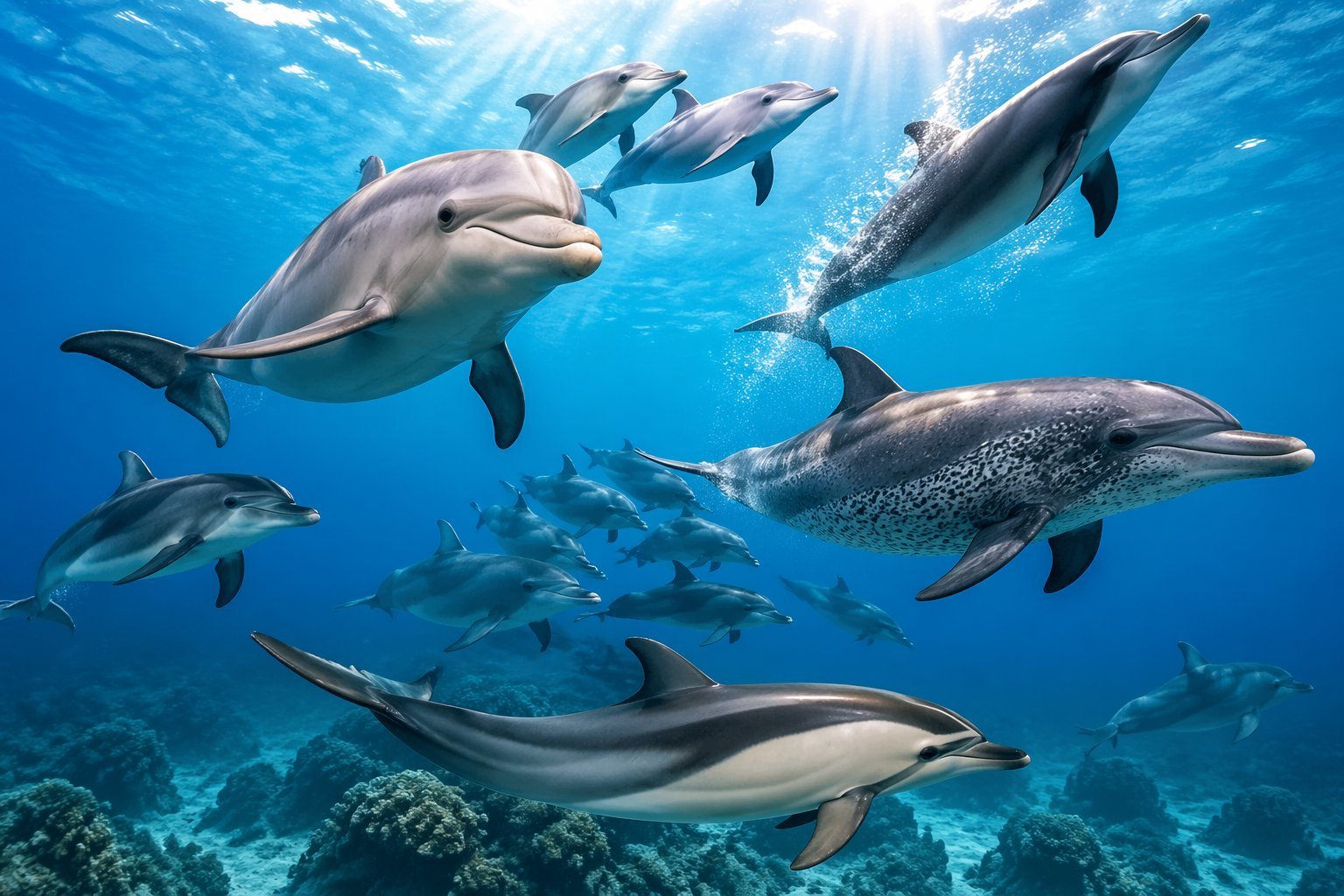
The species most people picture when they hear “dolphin” are members of the family Delphinidae. Four of them consistently draw the most attention from researchers, wildlife watchers, and the general public alike.
Bottlenose Dolphin
The bottlenose dolphin is the most recognized dolphin species in the world. Two species carry this name:
| Species | Scientific Name | Key Feature |
|---|---|---|
| Common bottlenose dolphin | Tursiops truncatus | Larger, widely distributed globally |
| Indo-Pacific bottlenose dolphin | Tursiops aduncus | Smaller, spotted belly, coastal Indo-Pacific |
Common bottlenose dolphins reach about 8 to 12 feet in length and are gray with a lighter underside. They are the species most frequently seen in coastal US waters and are the most common dolphin in captivity.
Common Dolphin
Despite the name, many people are less familiar with the common dolphin than with the bottlenose. Two species are recognized:
- Short-beaked common dolphin (Delphinus delphis): Found offshore in temperate and tropical seas
- Long-beaked common dolphin: Found in warmer, shallower coastal waters
Both species display a distinctive hourglass color pattern on their sides, with yellowish and gray patches, making them relatively easy to identify at sea.
Spinner Dolphin
The spinner dolphin (Stenella longirostris) is named for its acrobatic leaping behavior, spinning along its longitudinal axis as it jumps clear of the water. It is a slender, tropical species with a long, narrow beak and a tricolored body pattern.
Spinner dolphins are commonly seen in the Pacific, including waters around Hawaii, and often associate with yellowfin tuna, a behavior that historically made them vulnerable to tuna fishing nets.
Orca and Why the Killer Whale Is a Dolphin
The orca (Orcinus orca), widely known as the killer whale, is the largest member of the family Delphinidae, reaching up to 9.5 meters (31 feet) and 10 tonnes. It is unambiguously a dolphin from a taxonomic standpoint, despite its size and common name.
Orcas are apex predators with a highly varied diet that can include fish, seals, other cetaceans, and seabirds. Their distinctive black-and-white coloration makes them immediately recognizable.
Other Notable Oceanic Species
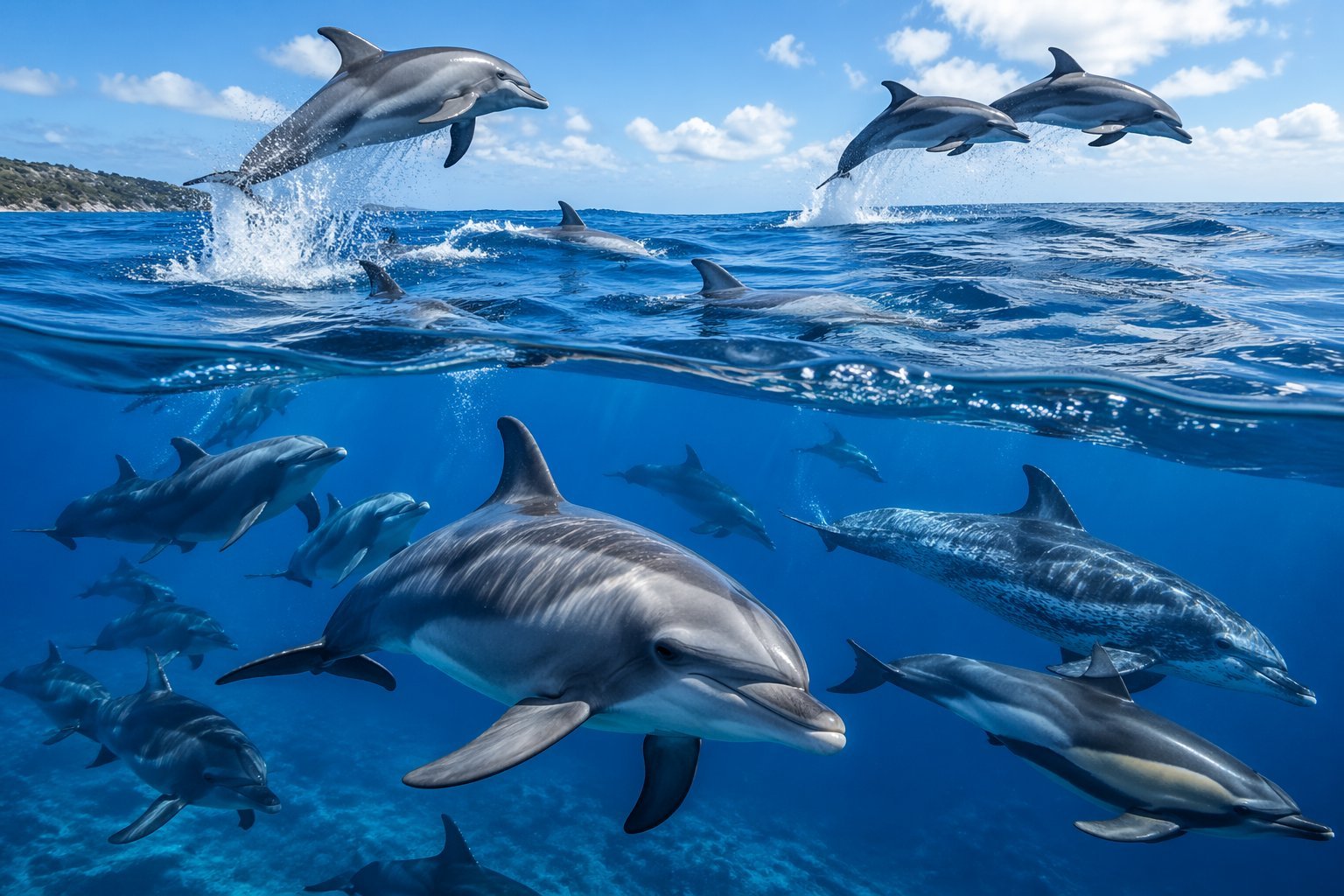
Beyond the headline species, the Delphinidae family contains dozens of additional dolphins with distinct ranges, appearances, and behaviors. These range from cold-water specialists found near Antarctica to coastal humpback dolphins visible from beaches in West Africa and Australia.
Spotted, Striped, and White-Sided Dolphins
Several Delphinidae species are recognizable by bold color patterns:
- Atlantic spotted dolphin (Stenella frontalis): White spots on a gray body, spots increase with age
- Pantropical spotted dolphin (Stenella attenuata): Similar spots, found across tropical oceans worldwide
- Striped dolphin (Stenella coeruleoalba): A distinctive blue and white stripe running from the eye to the flank
- Atlantic white-sided dolphin (Lagenorhynchus acutus): White and yellow patches on the flank, cold North Atlantic waters
- Pacific white-sided dolphin: Similar pattern, found in temperate North Pacific seas
- White-beaked dolphin: A stocky, cold-water species of the North Atlantic
Striped dolphins are among the most abundant cetaceans in the Mediterranean Sea. Atlantic white-sided dolphins are frequently spotted on whale-watching trips off New England and eastern Canada.
Humpback and Coastal Dolphins
The humpback dolphins form a genus (Sousa) of coastal, shallow-water specialists. Currently recognized species include:
- Indo-Pacific humpback dolphin (Sousa chinensis), also called the Chinese white dolphin in some regions
- Atlantic humpback dolphin (Sousa teuszii): West African coasts, critically endangered
- Australian humpback dolphin (Sousa sahulensis)
Named for a hump beneath their dorsal fins, these dolphins are generally found close to shore in warm, shallow waters. The Irrawaddy dolphin is a related coastal and freshwater-linked species with a rounded, beak-less head that distinguishes it from most other delphinids. The Australian snubfin dolphin, similar in appearance, was only formally described as a separate species in 2005.
The rough-toothed dolphin (Steno bredanensis) and Risso’s dolphin (Grampus griseus) round out the notable coastal and offshore species. Risso’s dolphins are particularly distinctive because of heavy scarring on their bodies, caused by interactions with squid and other dolphins.
Fraser’s dolphin (Lagenodelphis hosei) and the Guiana dolphin are also members of this family, the latter residing along the Atlantic coast of South America and sometimes entering estuaries.
Pilot Whales, False Killer Whales, and Close Relatives
Like the orca, several large delphinids are commonly called whales despite being classified as dolphins:
- Long-finned pilot whale (Globicephala melas): Found in cold temperate waters of both hemispheres
- Short-finned pilot whale (Globicephala macrorhynchus): Prefers warmer, tropical, and subtropical seas
- False killer whale (Pseudorca crassidens): Slender, all-dark body, found in deep tropical waters globally
- Melon-headed whale: Small, tropical, often found in large offshore schools
- Pygmy killer whale: Rarely seen, similar coloring to the false killer whale but smaller
All of these are classified within Delphinidae. The Clymene dolphin (Stenella clymene), sometimes called the short-snouted spinner dolphin, is a smaller species found in the Atlantic that is often confused with the spinner dolphin.
Cold-Water and Southern Hemisphere Dolphins
Several species are adapted specifically to cool or polar waters:
- Hourglass dolphin (Lagenorhynchus cruciger): A striking black-and-white Antarctic species, one of the few delphinids regularly seen in Antarctic seas
- Dusky dolphin: Found in the Southern Hemisphere, known for highly acrobatic behavior
- Peale’s dolphin: A subantarctic species of South American coastal waters
- Commerson’s dolphin (Cephalorhynchus commersonii): A small, strongly contrasting black-and-white dolphin found around the Falkland Islands and southern South America
- Chilean dolphin (Cephalorhynchus eutropia): Small, dark-colored, restricted to Chilean coastal waters
- Heaviside’s dolphin (Cephalorhynchus heavisidii): Found along the cold Benguela Current off southern Africa
- Northern right whale dolphin (Lissodelphis borealis): Unusual for having no dorsal fin, found in the North Pacific
- Southern right whale dolphin: The southern counterpart, equally streamlined and fin-less
River and Estuary Specialists
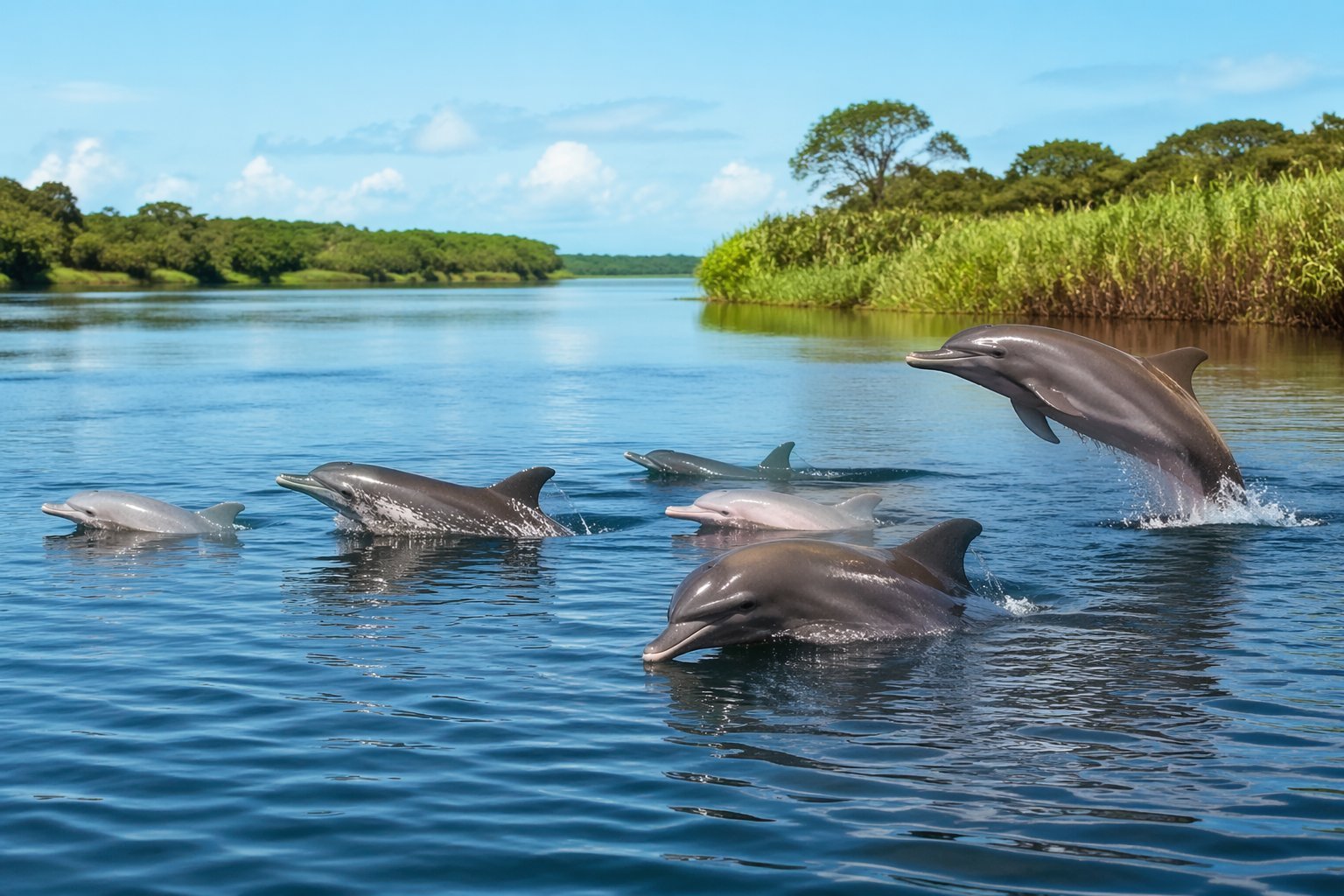
River dolphins represent some of the most evolutionarily distinct dolphin lineages on Earth. They are generally more vulnerable than oceanic species due to their restricted ranges and freshwater habitat overlap with human activity.
Amazon River Dolphin, Pink River Dolphin, and Boto
The Amazon river dolphin (Inia geoffrensis), also called the boto or pink river dolphin, is the largest river dolphin species. Adults can reach up to 8 feet in length and develop a pink coloration with age, particularly in males.
Botos live throughout the Amazon and Orinoco river basins in South America. Unlike most oceanic dolphins, they have unfused neck vertebrae, which allows them to turn their heads sideways, an adaptation useful for maneuvering through flooded forest environments.
Ganges and Indus River Dolphins
The Ganges river dolphin and Indus river dolphin were long considered subspecies of a single species but are now recognized as separate species within the family Platanistidae. Both are functionally blind, relying almost entirely on echolocation to navigate and hunt in the sediment-heavy rivers of South Asia.
They swim on their sides and use a flipper to stir the riverbed while foraging. Both species are endangered, threatened by dams, irrigation projects, pollution, and entanglement in fishing nets.
Baiji and the Yangtze River Dolphin
The baiji (Lipotes vexillifer), also called the Chinese river dolphin or Yangtze river dolphin, was declared functionally extinct following a 2006 survey that found no living individuals. It was a pale blue-gray dolphin with a long, upturned snout, endemic to the Yangtze River in China.
The baiji is widely considered the first dolphin species to have been driven to extinction by human activity. Its loss was caused by heavy river traffic, overfishing, dam construction, and pollution.
Franciscana, Tucuxi, and Other Nearshore Freshwater-Linked Species
The franciscana (Pontoporia blainvillei), also called the La Plata dolphin, is not a true river dolphin despite its family placement (Pontoporiidae). It lives in shallow coastal and estuarine waters along the Atlantic coast of South America and is the only member of its family still living.
The tucuxi is a small dolphin found in both freshwater rivers and coastal marine waters of South America. It resembles a small bottlenose dolphin and is sometimes mistaken for one. The Irrawaddy dolphin, mentioned earlier among coastal delphinids, also regularly enters freshwater river systems in Southeast Asia, making it another species that bridges marine and freshwater habitats.
How to Tell Similar Animals Apart

Dolphins are regularly confused with several other animals, both closely related cetaceans and completely unrelated fish. Three comparisons come up most frequently: dolphins versus porpoises, dolphins versus whales, and mahi-mahi versus dolphins.
Dolphins vs. Porpoises
Dolphins and porpoises are both toothed whales (Odontoceti), but they belong to separate families and have clear physical differences:
| Feature | Dolphins | Porpoises |
|---|---|---|
| Beak | Pronounced, elongated | Short, rounded, no beak |
| Teeth | Conical | Spade-shaped |
| Dorsal fin | Curved or hooked | Triangular |
| Body size | Varies widely | Generally smaller |
| Social behavior | Often in large, active groups | Typically quieter, smaller groups |
The easiest identification feature is the snout. Dolphins have a clearly defined beak extending from the forehead; porpoises do not. Porpoises also tend to be less acrobatic than most dolphin species.
Are Dolphins Whales?
Dolphins are technically whales in a broad scientific sense, as all dolphins belong to the order Cetacea, which includes all whales. Within Cetacea, dolphins fall under the toothed whale parvorder (Odontoceti).
In practical usage, the term “whale” is applied to the larger cetaceans while smaller, beaked species are called dolphins. Several large delphinids, including the orca and pilot whales, demonstrate how this common-language boundary breaks down: they are named whales but classified as dolphins.
Why Mahi-Mahi Is Not a Dolphin
Mahi-mahi, also called dolphinfish, is a bony ocean fish with no relation to dolphins. The name “dolphin” was historically applied to mahi-mahi because the fish were sometimes seen swimming alongside ships at the same time as dolphins, and because of superficial similarities in behavior.
Mahi-mahi (Coryphaena hippurus) are true fish, not mammals, and are not classified in Cetacea or any related group. When ordering “dolphin” at a seafood restaurant, you are almost certainly being served mahi-mahi, not a marine mammal.
Size, Rarity, and Conservation Status
The range in size across dolphin species is striking. The orca at 9.5 meters and up to 10 tonnes represents the largest dolphin species, while Maui’s dolphin, a subspecies of Hector’s dolphin (Cephalorhynchus hectori maui), is among the smallest at around 1.7 meters. Several species face serious conservation threats, making species identification increasingly relevant to conservation efforts.
The Largest and Smallest Species
| Species | Size | Range |
|---|---|---|
| Orca (Orcinus orca) | Up to 9.5 m, 10 tonnes | Worldwide |
| Common bottlenose dolphin | Up to ~3.9 m | Worldwide |
| Amazon river dolphin | Up to ~2.5 m | Amazon/Orinoco basins |
| Hector’s dolphin | ~1.4 m | New Zealand coasts |
| Maui’s dolphin | ~1.7 m | West coast of New Zealand |
Maui’s dolphin is considered the world’s smallest and rarest marine dolphin. As of recent estimates, fewer than 50 mature individuals remain.
Endangered Dolphin Species to Know
Several dolphin species are currently listed as endangered or critically endangered:
- Maui’s dolphin: Critically endangered; restricted to a small area off New Zealand’s North Island
- Atlantic humpback dolphin (Sousa teuszii): Critically endangered; estimated fewer than 1,500 individuals remain along West African coasts
- Ganges river dolphin: Endangered; threatened by dam construction, pollution, and fishing pressure
- Indus river dolphin: Endangered; extremely fragmented population in Pakistan
- Amazon river dolphin: Listed as endangered; declining due to hunting for bait, habitat degradation, and mercury contamination
- False killer whale: Some populations, particularly the Hawaiian insular population, are listed as endangered
- Baiji: Almost certainly extinct since the mid-2000s
What Threatens Dolphins Worldwide
The main threats to dolphin populations globally are consistent across species:
- Bycatch and entanglement in fishing gear, including gillnets and longlines
- Habitat degradation, including river damming, dredging, and coastal development
- Pollution, including plastic debris, chemical runoff, and noise pollution that disrupts echolocation
- Direct hunting, which continues in some parts of Japan and Latin America
- Climate change, which alters prey distribution and ocean conditions
River dolphins face the most concentrated pressure because their habitat overlaps entirely with dense human populations and agricultural and industrial water use.
Frequently Asked Questions
How many dolphin species are there worldwide?
There are approximately 40 recognized living dolphin species, spanning the oceanic family Delphinidae and several river dolphin families. Taxonomic revisions occasionally change the count as species are split or reclassified based on genetic analysis.
Which dolphin species are most commonly seen by people?
The common bottlenose dolphin (Tursiops truncatus) is the species most frequently encountered in coastal waters, marine parks, and aquariums. Common dolphins, spinner dolphins, and Atlantic spotted dolphins are also frequently seen on ocean wildlife trips.
What are the main differences between oceanic dolphins and river dolphins?
Oceanic dolphins, primarily from the family Delphinidae, are generally more streamlined, have well-developed eyesight, and live in open or coastal marine waters. River dolphins have longer, narrower beaks, reduced or nonfunctional eyes, more flexible necks, and are adapted to shallow, murky freshwater systems.
Which dolphin species live in the Mediterranean Sea?
The striped dolphin is one of the most abundant cetaceans in the Mediterranean. Common dolphins, common bottlenose dolphins, Risso’s dolphins, and short-beaked common dolphins are also regularly encountered there.
Which dolphin species are commonly found in Florida waters?
The common bottlenose dolphin is by far the most frequently spotted dolphin in Florida’s coastal and inshore waters. Atlantic spotted dolphins are also common offshore in the Gulf of Mexico and Atlantic waters surrounding the state.
How can you identify different dolphin species by their physical features?
Key features to look for include beak length and shape, body size, coloration and pattern (spots, stripes, patches), the shape and placement of the dorsal fin, and geographic location. For example, the hourglass color pattern identifies common dolphins, the absence of a dorsal fin distinguishes right whale dolphins, and a rounded beak-less head is characteristic of the Irrawaddy dolphin.