Foxes belong to the canid family (Canidae), the same biological family as wolves, coyotes, and domestic dogs. When you hear the word “fox,” you likely picture a reddish animal with a pointed snout, triangular ears, and a bushy tail. That image fits, but the actual diversity of fox species is much broader than most people expect.

The world recognizes roughly 37 canid species commonly called foxes, spread across multiple genera and every continent except Antarctica. They range from the fennec fox of the Sahara Desert, weighing barely 3 pounds, to the red fox, which can top 30 pounds in some populations. Each species has developed physical and behavioral traits suited to its specific environment.
This guide covers types of foxes from a classification standpoint first, then moves into practical identification, regional species in North America, conservation status, and whether foxes are viable pets.
Key Takeaways
- Foxes belong to several distinct genera, and not all animals called “foxes” are true foxes in the scientific sense.
- North America is home to at least five fox species, including the red fox, gray fox, arctic fox, kit fox, and swift fox.
- Most fox species are not suitable as pets, though a small number of domesticated and semi-domesticated exceptions exist.
How Foxes Are Classified

Fox classification involves multiple genera within the canine family, and the distinction between “true foxes” and other fox-like canids matters when you are trying to identify or research a specific species. The genera Vulpes, Urocyon, Otocyon, Lycalopex, and Cerdocyon each contain species commonly called foxes, though their evolutionary relationships differ.
What Makes a Fox a Canid
Foxes are members of the family Canidae, which includes dogs, wolves, jackals, coyotes, the maned wolf, the Ethiopian wolf, the dhole, and the bush dog. All canids share certain skeletal and behavioral traits, including digitigrade locomotion (walking on their toes), a generally carnivorous or omnivorous diet, and social communication through vocalizations and scent marking.
Foxes occupy a specific niche within this family. They tend to be smaller, more solitary, and more broadly omnivorous than wolves or dogs.
True Foxes vs. Other Fox-Like Canids
The term “true fox” refers specifically to members of the genus Vulpes. There are 12 recognized species in this genus, including the red fox (Vulpes vulpes), the fennec fox (Vulpes zerda), and the arctic fox (Vulpes lagopus).
Other animals called foxes belong to different genera. The gray fox belongs to Urocyon, the bat-eared fox to Otocyon, South American foxes to Lycalopex, and the crab-eating fox to Cerdocyon. The raccoon dog is sometimes mentioned alongside foxes in popular articles but is not a fox at all.
How Many Fox Species Are There
The IUCN recognizes approximately 37 species within the Canidae family that are commonly referred to as foxes across all genera. Of these, 12 are true foxes in the Vulpes genus. The remaining species are fox-like canids that belong to other genera, and their classification as “foxes” is largely a common-name convention rather than a strict taxonomic grouping.
The Main Fox Groups and Notable Species

The major fox groups span multiple continents and environments, from Arctic tundra to equatorial forest. The most widely encountered species fall into a few key groups: the large, adaptable true foxes of the Vulpes genus, the distinctive South American foxes of Lycalopex, and the taxonomically separate gray fox and bat-eared fox.
Red Fox and Its Color Forms
The red fox (Vulpes vulpes) is the largest true fox and holds the widest natural range of any terrestrial carnivore aside from humans. Adults typically measure 90 to 105 cm in total length and weigh between 5 and 7 kg, though some individuals are heavier.
Its coat is typically reddish-brown, but color variation is notable. The silver fox is a melanistic color form with a black coat and white-tipped hairs. The black fox is a fully melanistic variant. A cross fox shows a dark band across the shoulders. All of these are the same species (Vulpes vulpes), not separate types.
Arctic Fox and Cold-Climate Specialists
The arctic fox (Vulpes lagopus) is built specifically for cold environments, with a compact body, thickly furred paws, and a seasonal coat that shifts from white in winter to brown or gray in summer. It is among the few fox species found above the Arctic Circle.
The Tibetan fox (Vulpes ferrilata), also called the Tibetan sand fox, occupies high-altitude steppe in Central Asia. It is a medium-sized true fox with a notably broad, flat face that makes it visually distinct from other Vulpes species.
Fennec Fox and Other Desert Adaptations
The fennec fox (Vulpes zerda) is the smallest wild canid, typically weighing 1.5 to 3.5 pounds. Its oversized ears, which can reach 6 inches in length, serve as heat dissipation organs and acoustic amplifiers for detecting prey underground.
The kit fox and swift fox, both found in North America, also show desert and grassland adaptations. These include large ears, a lean body, and pale coats that provide camouflage in open terrain.
Gray Fox, Island Fox, and Bat-Eared Fox
The gray fox (Urocyon cinereoargenteus) is one of the few canids capable of climbing trees, using curved claws to grip bark. It is native to North and Central America and prefers forested habitats. The island fox (Urocyon littoralis), a close relative, is endemic to six of California’s Channel Islands and is significantly smaller than its mainland cousin.
The bat-eared fox (Otocyon megalotis) is native to Africa and feeds primarily on insects, especially harvester termites. Its massive ears function similarly to the fennec fox’s, but its diet is unusually specialized for a canid.
South American Foxes at a Glance
South American foxes belong mainly to the genus Lycalopex. They are often called “false foxes” because they are more closely related to wolves and jackals than to true Vulpes foxes.
Notable species include:
- Culpeo (Lycalopex culpaeus): The largest South American fox, comparable in size to the red fox, found from Ecuador to Patagonia.
- South American gray fox / Chilla (Lycalopex griseus): A smaller, widespread species in Argentina and Chile.
- Pampas fox (Lycalopex gymnocercus): Inhabits open grasslands and pampas in Argentina, Uruguay, and Brazil.
- Darwin’s fox (Lycalopex fulvipes): A small, critically endangered species found only in southern Chile.
- Sechuran fox (Lycalopex sechurae): A small species limited to the coastal deserts of Peru and Ecuador.
- Hoary fox (Lycalopex vetulus): A small insectivorous fox native to Brazilian cerrado.
- Crab-eating fox (Cerdocyon thous): Placed in its own genus; found in South American woodlands and savannas.
How to Identify a Fox in the Wild
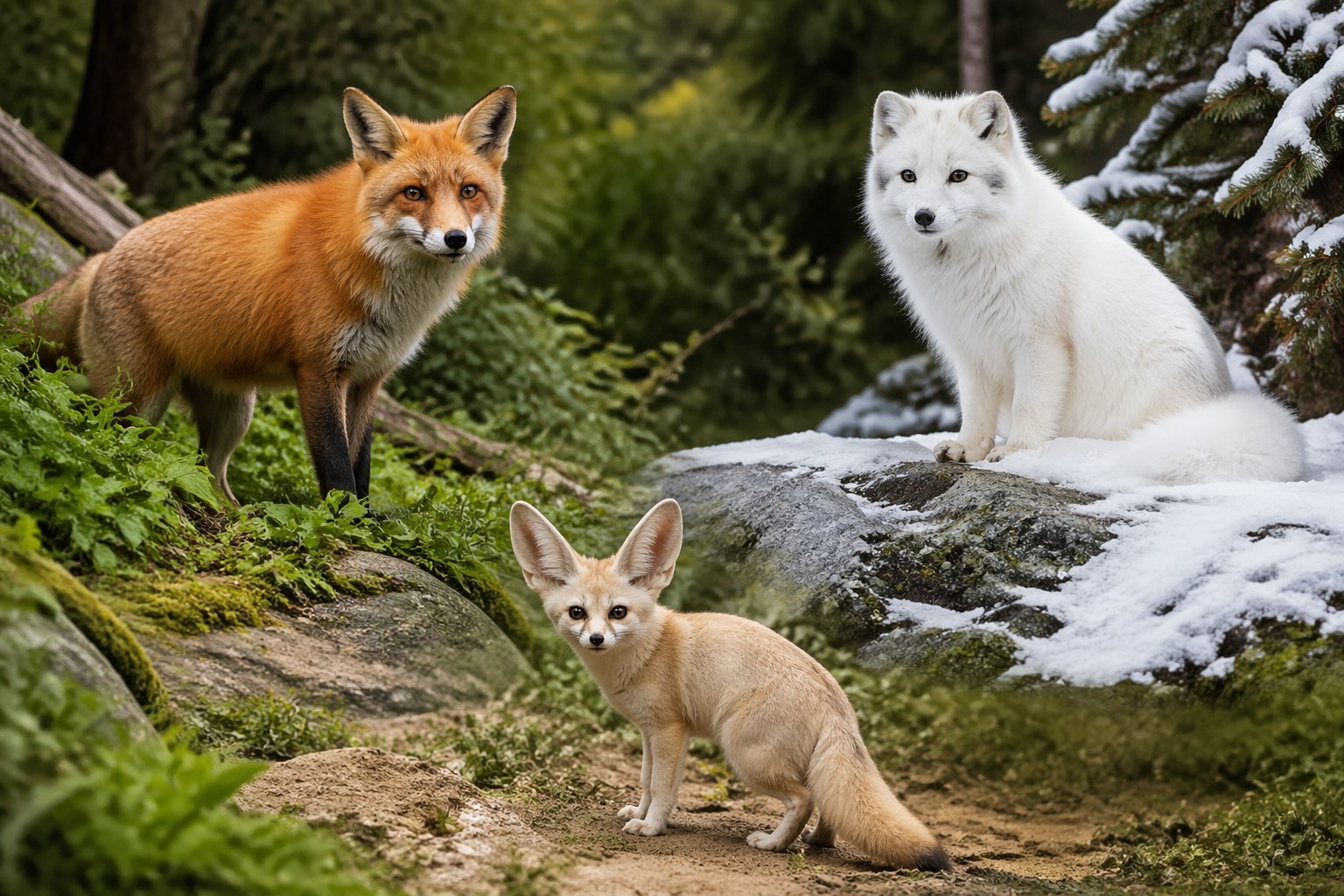
Identifying a fox in the field comes down to combining physical features with behavioral cues and geographic context. A species that is common in your region narrows the possibilities considerably before you even examine the animal closely.
Key Physical Traits to Look For
All foxes share a recognizable set of physical features, though the specifics vary by species:
- Flattened skull: Foxes have a distinctly flat-topped, elongated skull compared to dogs or coyotes.
- Triangular ears: Erect, pointed ears set close together on top of the head.
- Pointed snout: A narrow, tapered muzzle longer and more slender than a domestic dog’s.
- Bushy tail: A thick, well-furred tail that is typically more than half the body length; often white-tipped in the red fox.
Fox size varies widely across species. The fennec fox is the smallest at around 1.5 to 3.5 pounds. The red fox is the largest true fox, sometimes reaching 14 kg in heavier individuals, while the culpeo reaches a similar size among South American species.
Behavior, Calls, and Daily Activity
Most foxes are primarily nocturnal or crepuscular, meaning you are most likely to see them at dawn and dusk. The red fox is an exception in suburban settings, where it often moves during daylight hours.
Foxes are digitigrade, meaning they walk on their toes rather than flat-footed. Their tracks are typically oval and more compact than coyote tracks, and their stride pattern is usually a clean trot. Fox vocalizations include a sharp, high-pitched bark and a screaming call during breeding season, which often catches people off guard when heard at night.
Male, Female, and Young Fox Terms
Fox terminology follows consistent naming conventions:
- A male fox is called a tod (or dog fox in some regions).
- A female fox is called a vixen.
- Young foxes are called kits, pups, or occasionally cubs.
- A group of foxes is called a skulk or an earth.
Fox subspecies further complicate identification. The red fox alone has dozens of recognized subspecies across its global range, and regional variation in coat color and body size is significant.
Foxes in North America by Region
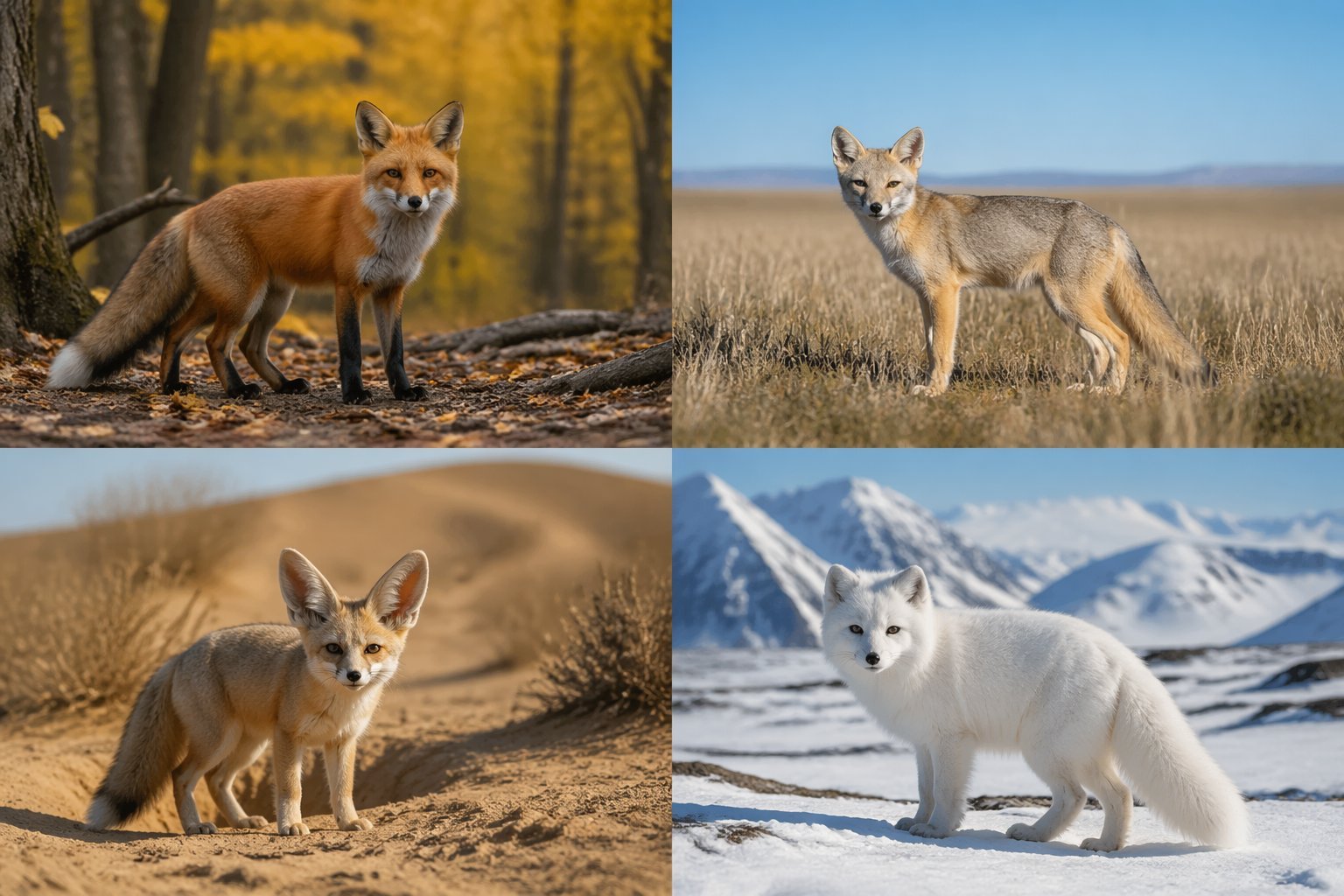
North America supports a diverse fox population, with at least five well-established species and several notable subspecies. The species you encounter depends heavily on which region you are in, and in some areas, two or more species overlap.
Common Species Across the Continent
The red fox (Vulpes vulpes) is the most widely distributed fox in North America, found from Alaska and Canada through most of the contiguous United States. It thrives in mixed landscapes, suburban areas, and agricultural land.
The gray fox (Urocyon cinereoargenteus) has a broad but more southerly range, covering most of the eastern and southwestern United States into Central America. It is the only fox native to eastern North America that regularly climbs trees.
Types Found in Texas and the South
Both the red fox and gray fox are present throughout Texas. The gray fox tends to occupy brushy and forested terrain, while the red fox is more visible in open and suburban areas.
The swift fox (Vulpes velox) extends into the Texas panhandle and Oklahoma, where short-grass prairie provides its preferred habitat. It is a small, pale-coated fox that is faster than its size suggests.
Types Found in California and the West
California is home to several fox species and subspecies. The gray fox is widespread throughout the state. The kit fox (Vulpes macrotis) is native to desert and semi-arid habitats in the interior and southern portions of the state. The San Joaquin kit fox is a federally endangered subspecies restricted to the San Joaquin Valley and surrounding foothills.
The Sierra Nevada red fox is a rare high-elevation subspecies with an extremely limited range in the Sierra Nevada and Cascade mountains. Population surveys suggest it is one of the rarest mammals in North America. California’s Channel Islands are also home to the island fox, a small endemic found only on those six islands.
The Cozumel fox, sometimes noted in fox species lists, is a small, poorly studied canid from Cozumel Island off the coast of Mexico. Its taxonomic status has been debated.
Arctic and Northern Range Species
The arctic fox (Vulpes lagopus) is the dominant fox species across Alaska and northern Canada. It follows seasonal prey availability and sometimes travels hundreds of miles on sea ice. Its range does not extend into the lower 48 states except under extreme conditions.
In Canada, the red fox overlaps with the arctic fox at the southern edge of the tundra zone, and hybridization has been documented in some areas.
Conservation Status and Rare Foxes
Foxes occupy a wide conservation spectrum, from the abundant red fox, listed as Least Concern by the IUCN, to critically endangered island and forest species with only a few hundred individuals remaining. Habitat loss, invasive species, disease, and human development drive the greatest threats.
Species of Greatest Conservation Concern
Darwin’s fox (Lycalopex fulvipes) is one of the rarest canids in the world. It is found only in the Valdivian temperate rainforest of southern Chile and on Chiloé Island. Estimates place the population at fewer than 1,000 individuals, and the IUCN lists it as Endangered.
The island fox (Urocyon littoralis) recovered significantly after near-extinction in the early 2000s due to golden eagle predation and disease. Several subspecies on individual Channel Islands are still listed as Endangered or Threatened.
The Cozumel fox is considered critically endangered or possibly extinct, given the lack of confirmed recent sightings and ongoing habitat destruction on the island.
Rare Subspecies and Island Endemics
The Sierra Nevada red fox and San Joaquin kit fox are both at-risk subspecies within the continental United States. The Sierra Nevada red fox has one of the smallest documented ranges of any canid in North America.
Island populations are particularly vulnerable because they cannot disperse to new areas if local conditions deteriorate. This makes the island fox’s subspecies, one for each of the six Channel Islands, uniquely exposed to extinction.
What Threatens Fox Populations
The primary threats to fox populations globally include:
- Habitat loss and fragmentation from agricultural expansion and urban development
- Invasive predators and competitors (red foxes introduced to Australia have devastated native wildlife populations)
- Vehicle collisions, which are a significant mortality source for suburban-adapted species like the red fox and gray fox
- Disease, particularly mange and rabies, which can reduce local populations sharply
- Targeted persecution in areas where foxes are considered agricultural pests
Pet Foxes and Fox-Like Dogs
Foxes attract significant interest as potential pets, partly because of their appearance and partly because some species, particularly the fennec fox, have gained popularity on social media. The reality of fox ownership is more complicated than the appeal suggests.
Can a Fox Be Kept as a Pet
In the United States, legality varies by state and even by county. Some states permit fennec fox ownership with no permit. Others ban all fox ownership outright, including California, New York, and Texas. Before considering a fox as a pet, you need to verify the specific laws in your jurisdiction.
Beyond legality, foxes have strong instincts, high activity needs, and scent-marking behaviors that make them genuinely difficult to manage in a household setting. Even captive-bred individuals retain wild behaviors.
Species Sometimes Kept in Captivity
The fennec fox (Vulpes zerda) is the most commonly kept species in the United States where permitted. It is small, relatively quiet, and somewhat tolerant of handling when socialized from a young age.
The silver fox is a domesticated color form of the red fox bred selectively in Russia over decades. These animals show measurably reduced fear responses compared to wild red foxes, but they are still not equivalent to domestic dogs in temperament or trainability.
Dogs That People Mistake for Foxes
Several dog breeds are frequently confused with foxes due to their physical resemblance:
- Shiba Inu: Red-coated, pointed ears, compact build; the most commonly mistaken breed.
- Finnish Spitz: Bright reddish-orange fur, upright ears, and a bushy curled tail.
- Pomeranian: Small, thick-coated, with a pointed muzzle and fox-like facial structure.
- Alaskan Klee Kai: Resembles a small husky but has the angular face of a fox.
- Icelandic Sheepdog: Spitz-type with triangular ears and a dense, often red-tinted coat.
These are all members of the same Canidae family as foxes, which explains the physical similarities, but they are domesticated dogs with no recent fox ancestry.
Frequently Asked Questions
How many fox species are recognized worldwide?
Approximately 37 species within the family Canidae are commonly called foxes across all genera. Of these, 12 are true foxes in the genus Vulpes. The total count varies slightly depending on whether certain subspecies are elevated to full species status.
What are the most common fox species found in North America?
The red fox (Vulpes vulpes) and gray fox (Urocyon cinereoargenteus) are the two most widespread species across North America. The arctic fox dominates northern and subarctic regions, while the kit fox and swift fox occupy western desert and central grassland habitats respectively.
Which fox species live in New Jersey and how can they be identified?
New Jersey is home to both the red fox and the gray fox. The red fox has a reddish-orange coat, white-tipped tail, and black legs, while the gray fox is grayer in color with rusty-red sides and a black-tipped tail. The gray fox also tends to stay closer to forested cover than the red fox.
Which fox species occur in Pennsylvania and what habitats do they prefer?
Pennsylvania supports populations of both the red fox and the gray fox. The red fox prefers open and mixed habitats including farmland edges and suburban areas, while the gray fox gravitates toward dense deciduous forest and brushy terrain throughout the state.
Where do different fox species live, and how do their ranges differ by region?
Fox ranges are strongly tied to climate and habitat type. True foxes in the Vulpes genus are distributed across North America, Europe, Asia, and Africa, with the red fox holding the broadest range. South American foxes (Lycalopex) are confined to South America, and the bat-eared fox is limited to Africa. No fox species are native to Antarctica or most oceanic islands.
How do fox species differ in behavior and temperament?
Fox behavior varies significantly by species. Red foxes and gray foxes are both adaptable and increasingly tolerant of humans in suburban environments, but neither is naturally sociable toward people. The fennec fox is more tolerable of handling when captive-raised compared to larger species. Arctic foxes are highly nomadic and dependent on seasonal prey cycles, giving them a more restless behavioral profile than forest-adapted species.