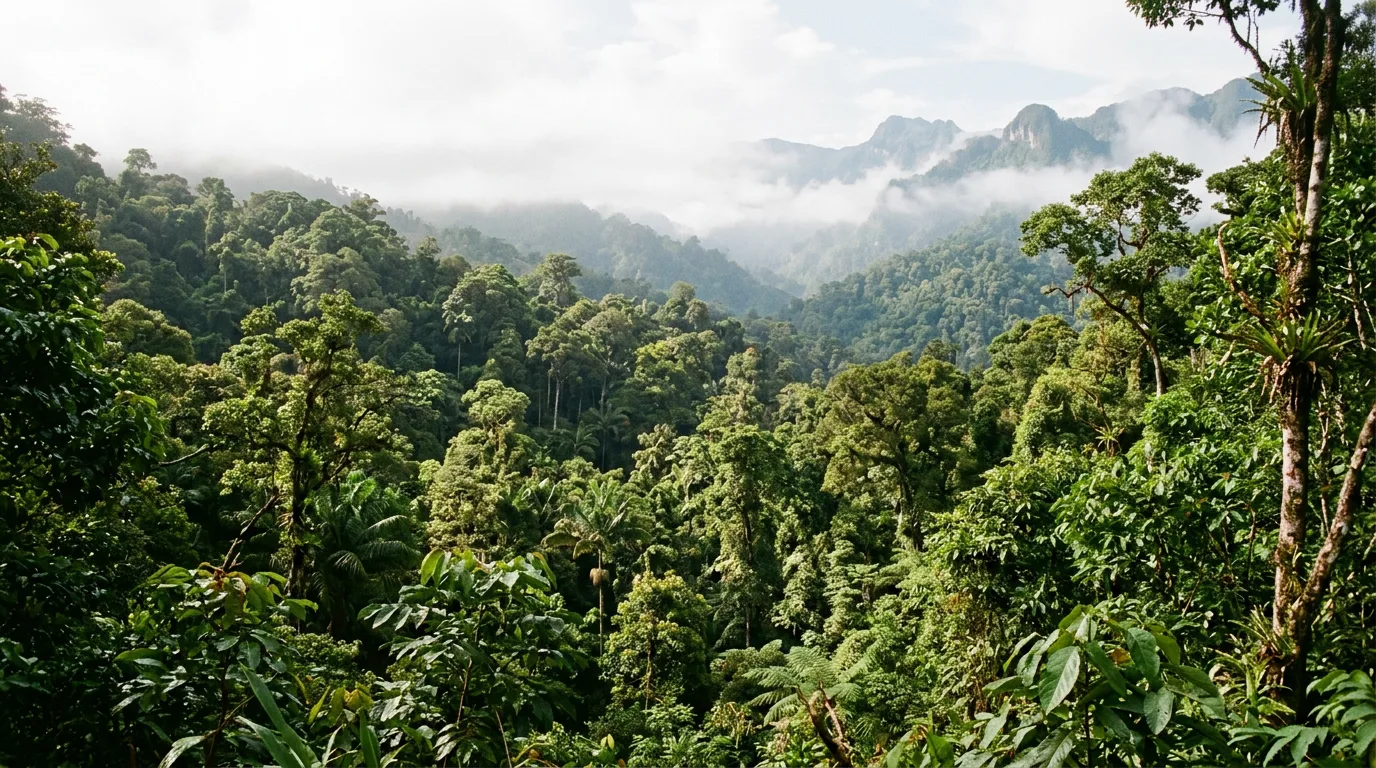
When it comes to types of monkeys, the first thing worth knowing is that there are over 260 recognized species, split into two major groups: Old World monkeys and New World monkeys. These primates range from the palm-sized pygmy marmoset to the mandrill, the largest monkey species on Earth. Understanding the difference between these two groups, and knowing how to identify common species, gives you a reliable framework for making sense of primate diversity.

Monkeys are not apes. That distinction matters, and it comes up often enough to address early: apes such as chimpanzees, gorillas, and gibbons belong to a separate group and lack tails. Monkeys, with very few exceptions, have tails, and that single feature is one of the clearest ways to tell them apart at a glance.
This guide covers how monkeys are classified, profiles the most recognizable species from both groups, and explains their behavior, habitats, and relationship with people.
Key Takeaways
- Monkeys are divided into two main groups based on geography: Old World monkeys from Africa and Asia, and New World monkeys from Central and South America.
- Key physical traits such as tail type, nostril shape, and cheek pouches help distinguish monkey groups and individual species.
- Monkeys are not apes, and most species face real conservation threats from habitat loss and the exotic pet trade.
How Monkeys Are Classified

Monkey classification comes down to two fundamental divisions rooted in geography and anatomy. New World monkeys are found in the Americas, while Old World monkeys live across Africa and Asia. Several physical traits reliably separate the two, making identification much more straightforward once you know what to look for.
New World Monkeys
New World monkeys belong to the superfamily Ceboidea and are distributed across southern Mexico, Central America, and South America. The group includes around 179 species spread across five families: Cebidae, Callitrichidae, Atelidae, Pitheciidae, and Aotidae.
One of their most distinctive features is the shape of their nostrils. New World monkeys have wide, flat noses with nostrils that face outward or sideways, a trait reflected in their scientific classification as platyrrhines.
Many New World species also possess prehensile tails, which function almost like a fifth limb, gripping branches and supporting the body’s weight. Not all New World monkeys have this adaptation, but it is more common among them than in Old World species.
Old World Monkeys
Old World monkeys belong to the family Cercopithecidae and are spread across Africa and Asia, with one small population in Europe. The family contains 23 genera and around 160 species, including baboons, macaques, colobus monkeys, langurs, and guenons.
Their nostrils are narrower and point downward, a trait that places them in the catarrhine group alongside apes and humans. Old World monkeys do not have prehensile tails, but many species have other notable adaptations.
Key Traits Used to Identify Monkey Groups
| Feature | New World Monkeys | Old World Monkeys |
|---|---|---|
| Nostril shape | Wide, sideways-facing | Narrow, downward-facing |
| Prehensile tail | Present in many species | Absent in all species |
| Cheek pouches | Absent | Present in many species |
| Native range | Americas | Africa, Asia, Europe |
| Habitat preference | Primarily arboreal | Arboreal and terrestrial |
Well-Known New World Species

New World monkeys include some of the most recognizable primates in the world, from the acrobatic spider monkey to the tiny pygmy marmoset. Species vary widely in size, social structure, and behavior, but most share a preference for arboreal life in tropical forest environments.
Capuchins
Capuchin monkeys are among the most widely recognized New World primates. The tufted capuchin (Sapajus apella) is a common representative of the group, known for its stocky build and the tuft of darker fur on its head.
Capuchins are highly intelligent. In the wild, they use rocks to crack open nuts and other hard-shelled food items. They are also socially complex, living in groups and using vocalizations, including whistles, to alert others to threats such as approaching boa constrictors.
Their combination of intelligence and trainability has made capuchins visible in films and television, though this visibility has also contributed to demand in the exotic pet trade.
Spider Monkeys
Spider monkeys (Ateles geoffroyi and related species) have exceptionally long limbs and some of the most developed prehensile tails among all primates. They can suspend their full body weight from a branch using only their tail.
Unusually, spider monkeys lack thumbs. They compensate with hook-like hands and their strong prehensile tails, which they also use to interact socially, wrapping tails around each other in greeting.
Spider monkeys are found across parts of Central and South America, primarily in dense rainforest canopies.
Howler Monkeys
Howler monkeys are the loudest land animals in the Western Hemisphere. Their vocalizations, produced by an enlarged hyoid bone in the throat, can carry for up to three miles through forest. There are 15 species of howler monkey found across Central and South America, including the black howler (Alouatta caraya).
Groups of howler monkeys call at dawn and dusk to announce their territory to neighboring groups.
Marmosets and Tamarins
Marmosets are small, squirrel-sized New World monkeys found in South American rainforests. The pygmy marmoset (Cebuella pygmaea), also called the eastern pygmy marmoset, holds the distinction of being the smallest monkey species in the world, weighing as little as 3.5 ounces.
Unlike most New World monkeys, marmosets do not have prehensile tails, though they use their tails for balance.
Tamarins are closely related to marmosets and similarly small. Notable species include:
- Golden lion tamarin (Leontopithecus rosalia): Bright orange fur, endangered, native to Brazil’s Atlantic Forest
- Cotton-top tamarin: White crest of hair on the head, critically endangered
- Emperor tamarin: Known for its long white mustache
Squirrel Monkeys and Night Monkeys
Squirrel monkeys (Saimiri, including Saimiri sciureus) are small, energetic primates found across Central and South America, including populations of the Central American squirrel monkey. They live in large social groups and are active during daylight hours.
Night monkeys stand apart as the only truly nocturnal monkeys in the world. Their large eyes are an adaptation for low-light vision, earning them the common nickname “owl monkeys.” Eleven species exist, native to Panama and South America.
Other notable New World species include titi monkeys, woolly monkeys, the bald uakari (recognized by its vivid red face and white fur), and uakaris more broadly.
Well-Known Old World Species
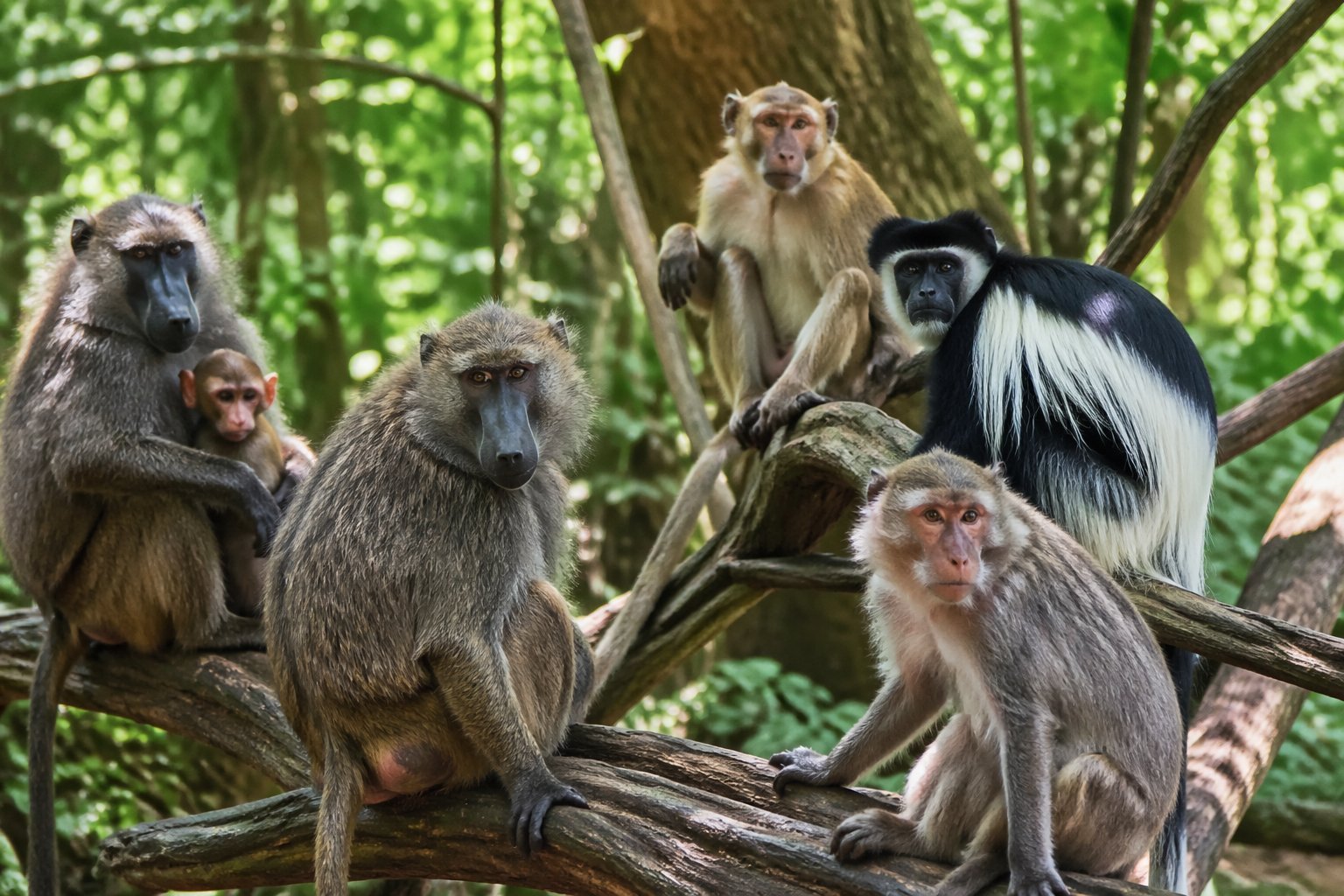
Old World monkeys span an enormous geographic range and include some of the most socially complex primates outside of apes. From the highly adaptable macaque to the striking mandrill, this group shows considerable variation in size, habitat, and behavior.
Macaques
Macaques (Macaca) represent one of the most geographically widespread primate genera, with 23 recognized species distributed across Africa and Asia. The rhesus macaque (Macaca mulatta) is arguably the best-known species, widely studied in biomedical research.
The Japanese macaque (Macaca fuscata), also called the snow monkey, is famous for bathing in geothermal hot springs during winter months in Japan.
Other well-known macaque species include:
- Long-tailed macaque (Macaca fascicularis), also called the crab-eating macaque, found across Southeast Asia
- Barbary macaque, the only wild monkey population in Europe, living on the Rock of Gibraltar
- Bonnet macaque, found in southern India
Macaques are highly social and communicate through vocalizations, facial expressions, and body posture.
Baboons
Baboons are among the largest Old World monkeys, with some males reaching 34 inches in height and over 80 pounds in weight. There are six species, including the olive baboon (Papio anubis), yellow baboon (Papio cynocephalus), chacma baboon, and hamadryas baboon.
All baboon species are native to Africa. They are terrestrial primates that live in large social groups called troops, which can number in the hundreds.
Mandrills and Drills
The mandrill (Mandrillus sphinx) is the largest monkey species in the world. Males display vivid red and blue markings on their faces and hindquarters, coloring that intensifies with social dominance. Mandrills are found in the rainforests of western and central Africa.
The drill is closely related to the mandrill, sharing a similar stocky build and short tail, and is restricted to a small range in Nigeria, Cameroon, and Equatorial Guinea. Both species are sometimes grouped with baboons due to shared ancestry, but they occupy their own genus.
Langurs, Colobus, and Leaf Monkeys
Langurs and leaf monkeys are Old World primates adapted to diets heavy in leaves. Their stomachs are divided into sacs that help break down cellulose and neutralize plant toxins. The dusky leaf monkey (Trachypithecus obscurus) is one well-studied example from Southeast Asia.
Colobus monkeys are African tree-dwellers that also rely heavily on leaves. They lack thumbs, an adaptation that improves their grip on branches. Infants are born with white fur, which darkens into the species’ characteristic patterning as they mature.
Vervets, Guenons, and Mangabeys
Vervet monkeys (Chlorocebus pygerythrus) are highly adaptable African primates found across a wide range of habitats, from savannas to forest edges. They have been introduced to several Caribbean islands and parts of Florida.
Guenons make up one of the largest groups of Old World monkeys, with 26 species distributed across sub-Saharan Africa. The mona monkey and the blue monkey are among the more recognized guenon species. Many guenons use large cheek pouches to store food.
Mangabeys are a group of 13 African species, several of which are rare or endangered. The red-capped mangabey is identified by a distinctive patch of reddish-brown fur on its head. Allen’s swamp monkey is another notable species within the group.
The patas monkey (Erythrocebus patas) is a terrestrial African species capable of running at over 30 miles per hour, making it the fastest primate on Earth.
Green monkeys and grivets are closely related to vervets and share similar habitat preferences in eastern and central Africa.
Proboscis Monkeys and Snub-Nosed Monkeys
The proboscis monkey (Nasalis larvatus) is immediately recognizable by the large, fleshy nose of adult males. This nose amplifies vocalizations and plays a role in mate attraction. Proboscis monkeys are native to the island of Borneo and are considered endangered.
Snub-nosed monkeys, including the golden snub-nosed monkey and the black snub-nosed monkey, are found in the mountain forests of China. Their upturned, flattened noses are an adaptation to cold mountain climates. Both species are threatened by habitat loss.
Geladas, found only in the Ethiopian highlands, are sometimes mistaken for baboons. They are technically their own distinct genus and are identified by a patch of bare red skin on their chests.
Habitats, Diet, and Social Behavior
Monkeys occupy a remarkable range of environments and have developed diverse strategies for finding food, avoiding predators, and maintaining social bonds. Physical adaptations like prehensile tails and cheek pouches connect directly to these ecological pressures.
Where Monkeys Live Around the World
Monkeys are naturally found in Africa, Asia, and the Americas. Most species prefer tropical and subtropical regions, including rainforests, savannas, mangrove swamps, and mountain forests.
Spider monkeys and howler monkeys are canopy specialists that rarely descend to the ground. Baboons and macaques spend significant time on the ground and are among the most terrestrial of all monkey species. The night monkey is a unique case among New World primates, occupying forest habitats exclusively after dark.
Colobus monkeys tend to stay high in the forest canopy and rarely come to the ground even when food is scarce.
What Monkeys Eat
Most monkey species are omnivorous. A typical diet includes fruit, leaves, seeds, flowers, insects, and occasionally small vertebrates. Colobus monkeys are a notable exception, relying almost entirely on leaves.
Macaques near human settlements are known opportunistic foragers, taking fruit, crops, and food from people. Geladas are unusual among primates in that grasses and grass seeds make up the bulk of their diet.
Troops, Grooming, and Communication
Most monkey species are highly social and live in structured groups. Baboon troops can contain hundreds of individuals with clear dominance hierarchies. Macaques live in complex multi-male, multi-female groups.
Grooming serves a critical social function beyond hygiene: it reinforces alliances, reduces tension, and signals trust. Alarm calls are a well-documented form of communication in vervet monkeys and several other species, with distinct calls for different predator types.
Movement in Trees and on the Ground
Prehensile tails in species like spider monkeys and woolly monkeys allow for suspension feeding and efficient canopy travel. Old World monkeys lack this adaptation but often compensate with strong limbs suited for leaping between branches or running on all fours across open ground.
Patas monkeys are the most extreme example of terrestrial adaptation, built for speed rather than climbing.
Monkeys and People
The relationship between monkeys and people spans research, tourism, popular culture, and the controversial exotic pet trade. Several species are highly visible in human contexts, which shapes public perception in ways that are not always accurate or beneficial to the animals.
Monkeys in Research, Media, and Tourism
The rhesus macaque has played a central role in biomedical research for decades. The long-tailed macaque (crab-eating macaque) is similarly common in laboratory settings.
Japanese macaques, the snow monkeys, are a significant draw for wildlife tourism in Japan. Their behavior around hot springs has been extensively documented and photographed.
Capuchin monkeys have appeared in numerous films and television productions due to their trainability. The squirrel monkey has also been used in media and research. These appearances generate public interest in the species but can create misleading impressions about their suitability as pets.
Why Monkeys Do Not Make Good Pets
Marmosets and capuchins are among the species most frequently kept or requested as pets. Despite their small size and appealing appearance, both present serious challenges in captivity.
Monkeys are highly social animals that require constant interaction with other individuals of their species. Kept alone, they develop significant behavioral and psychological problems. They also have strong teeth capable of causing serious injury, long lifespans requiring decades of specialized care, and complex dietary needs.
Legal and Ethical Concerns Around the Pet Trade
Private ownership of monkeys is restricted or prohibited in many U.S. states. Federal law under the Captive Wildlife Safety Act and the Lacey Act regulates interstate commerce in primates.
Beyond legality, the pet trade drives capture of wild individuals, which directly harms wild populations of already-threatened monkey species. Buying a monkey as a pet most often means funding an industry that accelerates species decline.
Conservation and Common Misconceptions
Many monkey species face serious threats, and a few widely repeated misconceptions continue to muddy public understanding of what monkeys actually are. Accurate knowledge matters for both conservation support and basic animal education.
Threats Facing Monkey Populations
Habitat loss is the primary driver of population decline across primate species. Deforestation for agriculture, logging, and urban expansion reduces and fragments the forest habitats that most monkey species depend on.
The following species are among the most threatened:
- Golden lion tamarin: Endangered; less than 10% of Brazil’s Atlantic Forest remains
- Black howler monkey: Vulnerable to habitat fragmentation and hunting
- Proboscis monkey (Nasalis larvatus): Endangered; restricted to Borneo’s coastal forests
- Bald uakari: Vulnerable; dependent on Amazonian flooded forests
- Barbary macaque: Endangered; wild population in Morocco and Algeria is shrinking
- Mandrill: Vulnerable; affected by bushmeat hunting and forest clearance
Hunting, the live animal trade, and disease transmission from humans also contribute to population declines across both Old World and New World monkey species.
Monkeys vs. Apes
This distinction comes up repeatedly because the two groups are frequently confused. The simplest way to tell them apart: monkeys have tails; apes do not.
Apes, including chimpanzees, gorillas, orangutans, gibbons, and bonobos, are more closely related to humans than monkeys are. They also tend to be larger and have more complex cognitive abilities on average. Chimpanzees, despite being called monkeys in casual conversation, are apes.
How Many Monkey Species Are There
Current estimates recognize over 260 monkey species, though some taxonomic sources place the number higher as genetic research refines species boundaries. New World monkeys account for approximately 179 species, while Old World monkeys number around 160 species across the family Cercopithecidae.
New species continue to be formally described as field research and genetic analysis advance, particularly in remote forest regions of South America and Southeast Asia.
Frequently Asked Questions

What are the most common monkey species found around the world?
The rhesus macaque and long-tailed macaque are among the most geographically widespread monkey species, found across large parts of Asia. Vervet monkeys and olive baboons are similarly common across sub-Saharan Africa, while capuchin monkeys are frequently encountered throughout Central and South America.
How are monkeys classified, and what are the major groups?
Monkeys belong to the order Primates and are divided into two major groups: New World monkeys (Platyrrhini), native to the Americas, and Old World monkeys (Cercopithecidae), native to Africa and Asia. These groups are distinguished by nostril shape, tail type, and the presence or absence of cheek pouches.
What is the difference between monkeys and apes?
Monkeys have tails; apes do not. Apes, including chimpanzees, gorillas, orangutans, and gibbons, are a separate group of primates that are more closely related to humans than monkeys are. Referring to a chimpanzee or gorilla as a monkey is a common error, but these animals belong to a distinct classification.
Which monkey species are known for having unusually large noses?
The proboscis monkey (Nasalis larvatus) has the most dramatically enlarged nose of any primate, a feature found primarily in adult males. Snub-nosed monkeys, including the golden snub-nosed monkey and black snub-nosed monkey from China, represent the opposite extreme, with flattened, upturned nostrils adapted to cold, high-altitude environments.
Which monkey species are known for having especially large eyes?
Night monkeys, also called owl monkeys, have proportionally large eyes adapted for low-light and nighttime vision. They are the only truly nocturnal monkeys and their large eyes are one of their most immediately recognizable physical traits. Eleven species of night monkey exist across Panama and South America.
Where do the most well-known monkey species live, and what habitats do they prefer?
Capuchins, spider monkeys, and howler monkeys are found in the tropical forests of Central and South America, ranging from dense rainforest canopies to drier forest types. Macaques occupy a wide range of habitats across Asia, from tropical forests to temperate mountain environments. Baboons are primarily African savanna and woodland primates, while mandrills prefer dense equatorial rainforest.