

The Kipunji (Rungwecebus kipunji) is one of the most remarkable zoological discoveries of the 21st century. Hidden away in the remote, high-altitude forests of southern Tanzania, this large, vocal monkey was completely unknown to western science until 2003. Even more incredibly, genetic testing revealed it didn’t just belong to a new species—it belonged to an entirely new genus, the first new monkey genus discovered in over 80 years. Today, with a population hovering around just 1,100 individuals, the Kipunji is recognized as one of the most endangered primates in Africa, fighting for survival in a highly fragmented habitat.
Kipunji Quick Facts
| Scientific Name: | Rungwecebus kipunji |
| Common Names: | Kipunji, Highland Mangabey |
| Type of Animal: | Mammal (Primate) |
| Habitat: | Montane and sub-montane evergreen forests |
| Location: | Southern Highlands of Tanzania |
| Elevation: | 1,300 to 2,450 meters (4,265–8,038 ft) |
| Diet: | Omnivore (Leaves, shoots, fruit, bark, and insects) |
| Population: | ~1,117 individuals (based on comprehensive census data) |
| Conservation Status: | Endangered (IUCN) |
What Makes the Kipunji So Unusual?
The Kipunji stands out not just for its physical appearance, but for the incredible story of its classification:
- A “New Genus” Discovery: When first discovered, scientists thought it was a type of mangabey monkey. However, DNA testing in 2006 proved it was actually more closely related to baboons. Because it didn’t fit into either group, scientists had to create a brand-new genus (Rungwecebus) just for this animal.
- The “Honk-Bark”: The Kipunji has a highly distinctive, loud call described by researchers as a “honk-bark.” This loud vocalization helps troops communicate through the dense, foggy mountain canopy.
- Cold-Weather Adaptations: Because it lives at high altitudes where temperatures can drop near freezing, the Kipunji has evolved an unusually thick, long coat of grayish-brown fur, unlike the short-haired monkeys found in the hot African lowlands.
- The “Punk Rock” Crest: It features a highly recognizable, broad crest of long hair that stands straight up on the crown of its head.
Where It Lives: The Tanzanian Highlands
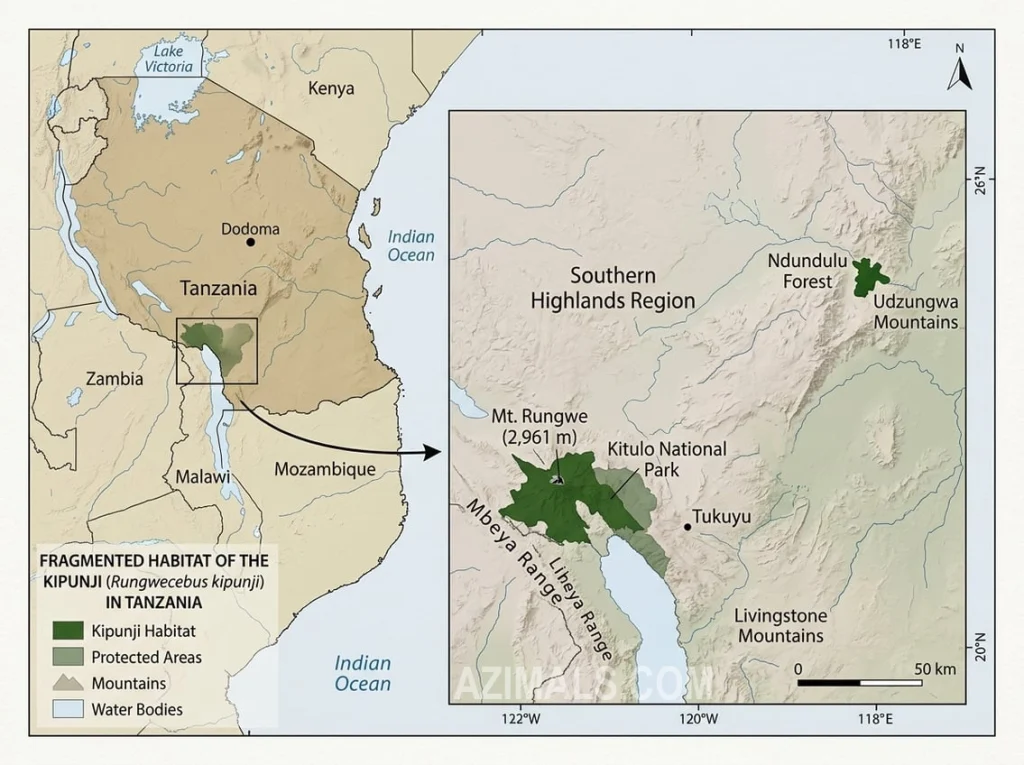
The Kipunji has an incredibly restricted range. It is endemic to Tanzania, meaning it is found nowhere else on Earth.
It survives in two isolated populations within montane evergreen forests, living at high elevations between 1,300 and 2,450 meters.
- The Main Population: The vast majority of Kipunji live in the forests of Mount Rungwe, the Livingstone Mountains, and the adjacent Kitulo National Park.
- The Ndundulu Population: A much smaller, entirely separate population lives roughly 250 miles away in the Ndundulu Forest of the Udzungwa Mountains.
Because these forests are separated by human settlements and agriculture, the two populations are completely cut off from one another.
What Does the Kipunji Eat?
The Kipunji is an opportunistic omnivore, spending its days foraging in the middle and upper canopy of the forest.
Living in a high-altitude environment means fruit is not always available year-round. To survive, the Kipunji has a highly varied diet. It feeds heavily on leaves, young shoots, pith, and bark. When available, it will eagerly consume ripe fruit, seeds, and flowers. To supplement its protein intake, troops will also forage for lichen, moss, and invertebrates like caterpillars and beetles hidden in the tree bark.
Kipunji vs. Other African Primates
How does the Kipunji compare to the monkeys it was originally confused with?
- Kipunji vs. Mangabeys: The Kipunji looks very similar to a mangabey (specifically in its face and tree-dwelling habits), but DNA proves it is genetically distinct. Mangabeys generally live in lower-altitude tropical forests, while the Kipunji is a highland specialist.
- Kipunji vs. Baboons: Genetically, the Kipunji is a close cousin to the baboon. However, baboons are primarily ground-dwelling, savanna animals with long, dog-like snouts. The Kipunji has a shorter snout and spends almost its entire life high in the trees.
Why is the Kipunji Endangered?
The IUCN classifies the Kipunji as Endangered. A comprehensive 2008 census recorded exactly 1,117 individuals, and their numbers remain under severe threat:
- Habitat Fragmentation: This is the greatest danger. The forests of Mount Rungwe are being rapidly degraded by illegal logging, charcoal production, and the expansion of local farms. As the forest shrinks, the monkey troops are forced into smaller, disconnected pockets. Like the Ader’s Duiker on the Tanzanian island, the Kipunji Monkey is suffering from severe forest fragmentation.
- Poaching: While not the primary target of commercial bushmeat hunters, Kipunji are frequently caught in wire snares set by poachers intending to catch forest antelopes or bush pigs.
- Human-Wildlife Conflict: As their natural forest food sources disappear, Kipunji troops occasionally raid local maize and bean farms, leading to retaliatory killings by farmers.
Frequently Asked Questions
The Kipunji was independently discovered by two different teams of researchers in 2003 and formally described to western science in 2005. Locals in Tanzania, however, had known about the monkey for generations.
Originally, scientists thought the Kipunji was a mangabey based on its appearance. However, DNA testing revealed it was actually more closely related to baboons. Because it was physically and genetically unique from both, it was placed in its own newly created genus, Rungwecebus.
Conservationists estimate that there are just over 1,100 Kipunji left in the wild. A highly detailed census conducted in 2008 counted exactly 1,117 individuals, making it one of Africa’s rarest primates.
The Kipunji is famous for its unique, loud call, which researchers describe as a “honk-bark.” This distinct vocalization helps the troop stay connected in the dense, low-visibility fog of their mountain habitat.