

The Ader’s Duiker (Cephalophus adersi), also known locally as the Zanzibar Duiker, is one of the rarest and smallest antelopes in Africa. Standing little more than a foot tall at the shoulder, this incredibly shy, forest-dwelling creature is famous for its striking reddish coat and the bright white band across its rump. Found only in a few shrinking patches of coastal forest in Zanzibar and Kenya, the Ader’s Duiker is a master of hiding in the dense underbrush. Today, with populations severely fragmented by illegal logging and hunting, it is teetering on the edge of extinction.
Ader’s Duiker Quick Facts
| Scientific Name: | Cephalophus adersi |
| Common Names: | Ader’s Duiker, Zanzibar Duiker, Nunga (in Swahili) |
| Type of Animal: | Mammal (Bovid) |
| Habitat: | Coastal thickets and coral rag forests |
| Location: | Unguja Island (Zanzibar) and the Arabuko-Sokoke Forest (Kenya) |
| Size: | 30–32 cm (12 inches) tall at the shoulder; weighs 12–15 kg |
| Diet: | Herbivore (Leaves, seeds, buds, and fallen fruit) |
| Conservation Status: | Critically Endangered (IUCN) |
What Makes the Ader’s Duiker So Unusual?
Unlike the massive herds of antelopes that roam the African savannas, the Ader’s Duiker is a solitary, secretive survivor with several unique adaptations:
- Miniature Size: It is incredibly small, weighing only about 25 to 33 pounds. Its compact, wedge-shaped body is perfectly designed to slip silently through dense, tangled forest undergrowth without getting snagged.
- The White Rump: It features a highly distinct, broad white band of fur across its hindquarters. In the dappled light of the forest floor, this acts as disruptive camouflage. When alarmed, the white flashes as a warning signal to other duikers before it vanishes into the brush.
- Monkey Partnerships: Ader’s Duikers have developed a brilliant foraging strategy. They are known to listen for troops of Sykes’ monkeys or red colobus monkeys feeding in the canopy above, waiting on the forest floor to eat the half-eaten fruits and seed pods the monkeys drop.
Where It Lives: Coastal Forests of East Africa
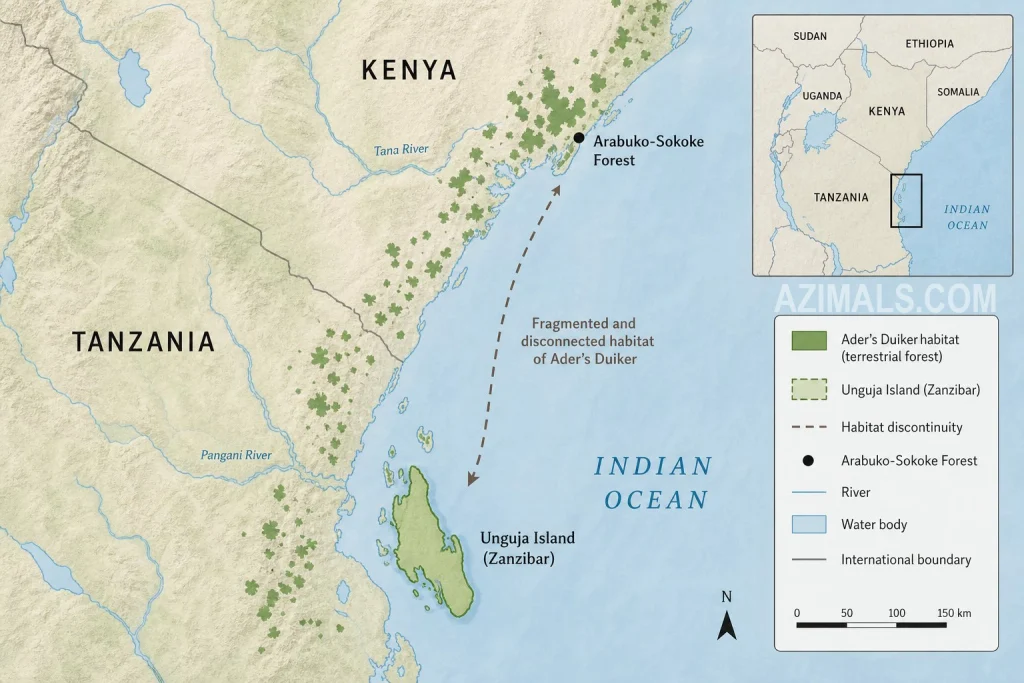
The Ader’s Duiker has an incredibly restricted and broken geographic range. It relies entirely on tall, undisturbed coastal forests and dense thickets.
Historically, the largest population has lived on Unguja Island (the main island of the Zanzibar archipelago in Tanzania), specifically in the dry “coral rag” forests—woodlands that grow over ancient coral reefs.
A second, even smaller remnant population exists on the mainland in the Arabuko-Sokoke Forest and the Boni-Dodori reserves on the coast of Kenya. These two populations are completely isolated from one another, meaning they cannot breed or share genetics, which puts the species at extreme risk.
What Does the Ader’s Duiker Eat?
The Ader’s Duiker is a highly selective herbivore and browser.
Because of its small size, it cannot reach high branches or digest tough, dry grasses. Instead, it relies on high-quality, easily digestible forest floor vegetation. Its diet consists primarily of broad green leaves, fresh buds, seeds, and fallen fruit.
They are entirely dependent on the canopy above them to provide food. If the tall trees are cut down, the duiker loses both its protective cover and its primary food source.
Ader’s Duiker vs. Savanna Antelopes
How does a forest duiker differ from a traditional savanna antelope like a gazelle or impala?
- Body Shape: Savanna antelopes have long legs and upright necks for running and spotting predators. Duikers have short front legs, longer hind legs, and an arched back, creating a wedge shape designed to dive headfirst into thick bushes.
- Social Structure: Savanna antelopes live in massive herds for protection. Ader’s Duikers are solitary or live in monogamous pairs, relying on stealth and camouflage rather than numbers.
- Horns: While many savanna antelopes have massive, spiraling horns, the Ader’s Duiker has tiny, backward-pointing spikes (usually 3 to 5 cm long) that won’t get tangled in vines.
Why is the Ader’s Duiker Endangered?
The IUCN classifies the Ader’s Duiker as Critically Endangered. Conservationists estimate that only a few hundred mature individuals remain in the wild.
- Habitat Destruction: This is the primary threat. The coastal forests of Zanzibar and Kenya are rapidly being cleared for illegal timber, agricultural expansion, and firewood collection. Like the Kipunji Monkey in the Tanzanian highlands, the Ader’s Duiker is suffering from severe forest fragmentation.
- Illegal Hunting: Despite being legally protected, they are heavily hunted using wire snares and hunting dogs to supply the local bushmeat trade.
- Feral Dogs: On Zanzibar, packs of feral and domestic dogs roam the forests, easily hunting down the tiny antelopes.
Frequently Asked Questions
The word “duiker” (pronounced dye-ker) comes from the Afrikaans word for “diver.” It refers to the animal’s habit of quickly diving headfirst into dense bushes and thickets when frightened.
They are miniature antelopes. An adult Ader’s Duiker stands only about 30 to 32 centimeters (roughly 12 inches) tall at the shoulder and weighs between 12 and 15 kilograms (26 to 33 pounds).
It is a selective browser that eats leaves, buds, seeds, and fruit found on the forest floor. They frequently follow troops of monkeys to scavenge the fruit that the monkeys drop from the canopy.
They are found in only two isolated locations in the world: the coastal coral rag forests of Unguja Island (Zanzibar, Tanzania) and tiny, fragmented forest patches on the coast of Kenya.