
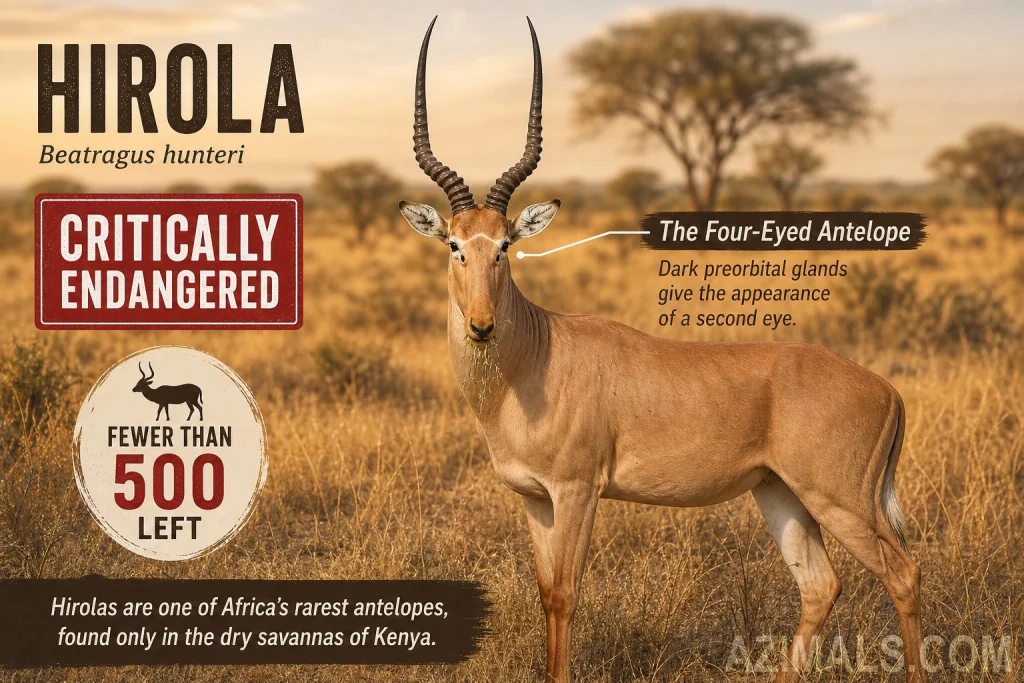
The Hirola (Beatragus hunteri) is one of the rarest and most critically endangered antelopes on the planet. Found only in a tiny pocket of arid grassland along the border of Kenya and Somalia, this elegant animal is often referred to as the “four-eyed antelope” due to the large, dark scent glands beneath its eyes. With an estimated global population of fewer than 500 individuals, the Hirola is the sole surviving member of its genus. Unlike many other endangered species, there are zero Hirola in captivity today, making the survival of these wild herds critical to preventing extinction.
Hirola Quick Facts
| Scientific Name: | Beatragus hunteri |
| Common Names: | Hirola, Hunter’s Hartebeest, Four-Eyed Antelope |
| Type of Animal: | Mammal (Bovid) |
| Habitat: | Dry savannas and semi-arid grasslands |
| Location: | The border region of eastern Kenya and southwestern Somalia |
| Diet: | Herbivore (Strict grazer of short grasses) |
| Population: | ~300 to 500 individuals |
| Conservation Status: | Critically Endangered (IUCN) |
What Makes the Hirola So Unusual?
The Hirola possesses several unique physical and survival traits that distinguish it from the rest of Africa’s grazing mammals:
- The “Four-Eyed” Illusion: The Hirola has pronounced, dark preorbital glands positioned just below its real eyes. When the antelope is excited or marking its territory, these glands open wide, creating the distinct illusion that the animal has four eyes.
- Evolutionary Orphans: The Hirola is the only living species in the genus Beatragus. If the Hirola goes extinct, an entire evolutionary lineage will vanish from the Earth.
- Waterless Survival: They are incredibly water-efficient. The Hirola can survive for long periods without drinking standing water, drawing the moisture they need directly from the vegetation they eat.
- Zero Captivity: Unlike rhinos or pandas, there is no “backup plan” for the Hirola. There are currently no Hirola housed in zoos or captive breeding programs anywhere in the world.
Where It Lives: The Kenya-Somalia Border

Historically, the Hirola roamed across a much larger stretch of East Africa. Today, their natural range has collapsed into a highly restricted area covering roughly 1,500 square miles along the border of eastern Kenya and southwestern Somalia.
The Hirola requires a very specific habitat: semi-arid grasslands and dry savannas. They actively avoid dense forests or thick bushland because they rely on open sightlines to spot predators like lions and cheetahs. Unfortunately, this specific habitat is disappearing as changing climates and overgrazing by livestock allow thick, thorny bushes to overtake the open grass.
What Does the Hirola Eat?
The Hirola is a strict herbivore and a selective grazer.
Instead of browsing on leaves or shrubs, its diet consists almost entirely of short grasses. Its wide muzzle and specialized teeth are perfectly evolved for cropping grass close to the ground. Because they inhabit a dry, drought-prone region, their ability to extract moisture from morning dew and grass stems allows them to roam far away from permanent water sources, avoiding areas where predators often wait in ambush.
Hirola vs. Other Antelopes
How does the Hirola stand out from the millions of other antelopes in Africa?
- Lineage: Most antelopes share a genus with several relatives. The Hirola is entirely alone on its evolutionary branch (Beatragus).
- Facial Features: While many antelopes have preorbital scent glands, the Hirola’s are exceptionally large and darkly pigmented, creating its signature “four-eyed” look.
- Horns: Both male and female Hirola possess sharply pointed, lyre-shaped horns with heavily ridged rings, whereas in many antelope species, only the males grow horns.
Why is the Hirola Endangered?
Classified as Critically Endangered by the IUCN, the Hirola’s population crashed violently in the 1980s and has never recovered.
- The Rinderpest Plague: In the 1980s, a devastating viral disease called rinderpest swept through East Africa. It wiped out an estimated 85% to 90% of the entire Hirola population in just a few years.
- Habitat Degradation: The open grasslands they rely on are being choked out by invasive tree and bush encroachment, largely driven by the overgrazing of domestic cattle and suppressed wildfires.
- Drought and Climate Change: Increasingly severe droughts in the Horn of Africa are drying up the short grasses the Hirola needs to survive. Unlike the Pemba Flying Fox, which has seen a massive population rebound, the Hirola continues to decline.
- Poaching: Though not heavily targeted for their horns, they are occasionally caught in snares or hunted for bushmeat in unstable border regions.
Frequently Asked Questions
The Hirola gets the nickname “four-eyed antelope” from the large, dark-colored preorbital scent glands located just below its actual eyes. When these glands open to mark territory, they look remarkably like a second set of eyes.
Conservationists estimate that there are only between 300 and 500 Hirola left in the wild, with fewer than 250 mature adults. This makes them one of the most critically endangered antelopes on Earth.
No. There are currently no Hirola in any zoo or captive breeding facility in the world. The entire global population exists exclusively in the wild along the Kenya-Somalia border.
The Hirola is a strict grazer. Its diet consists almost entirely of short grasses found in the semi-arid savannas of East Africa. It is highly water-efficient and rarely needs to drink from standing water sources.