

The Pemba flying fox (Pteropus voeltzkowi) is a massive, visually striking fruit bat endemic to a single island off the coast of East Africa. Boasting a wingspan of over 5 feet, it belongs to a group of animals known as “megabats.” Unlike the small, cave-dwelling bats most people are familiar with, the Pemba flying fox roosts high in the canopy of large trees, has a distinctively canine face, and relies entirely on its excellent vision and sense of smell to find food. Once pushed to the very brink of extinction in the 1990s, this giant bat is now celebrated as one of the world’s most incredible conservation success stories.
Pemba Flying Fox Quick Facts
| Scientific Name: | Pteropus voeltzkowi |
| Common Names: | Pemba Flying Fox, Pemba Fruit Bat |
| Type of Animal: | Mammal (Megabat) |
| Habitat: | Primary and secondary tropical forests, mangroves |
| Location: | Pemba Island (Zanzibar Archipelago, Tanzania) |
| Wingspan: | Up to 1.6 meters (5 ft 3 in) |
| Diet: | Frugivore (Fruit, nectar, and flowers) |
| Conservation Status: | Vulnerable (Population increasing) |
What Makes the Pemba Flying Fox So Unusual?
This giant bat shatters the common stereotypes associated with bats, playing a completely different ecological role in its environment:
- Massive Wingspan: It is one of the largest bat species in the world. While its body only weighs about 400 to 650 grams (roughly 1 to 1.4 lbs), its leathery wings can stretch over 5 feet across.
- Fox-Like Appearance: It gets its name from its bright tawny-orange fur, pointed ears, and elongated snout, which closely resemble a small canine or fox.
- No Echolocation: Unlike smaller bats that use echolocation to navigate in the dark, the Pemba flying fox does not have this ability. It navigates using highly developed eyesight and a keen sense of smell.
- Keystone Species: It acts as the “farmer of the forest.” By eating fruit and traveling long distances, it drops seeds across the island, making it directly responsible for the regeneration of Pemba’s forests.
Where It Lives: Pemba Island
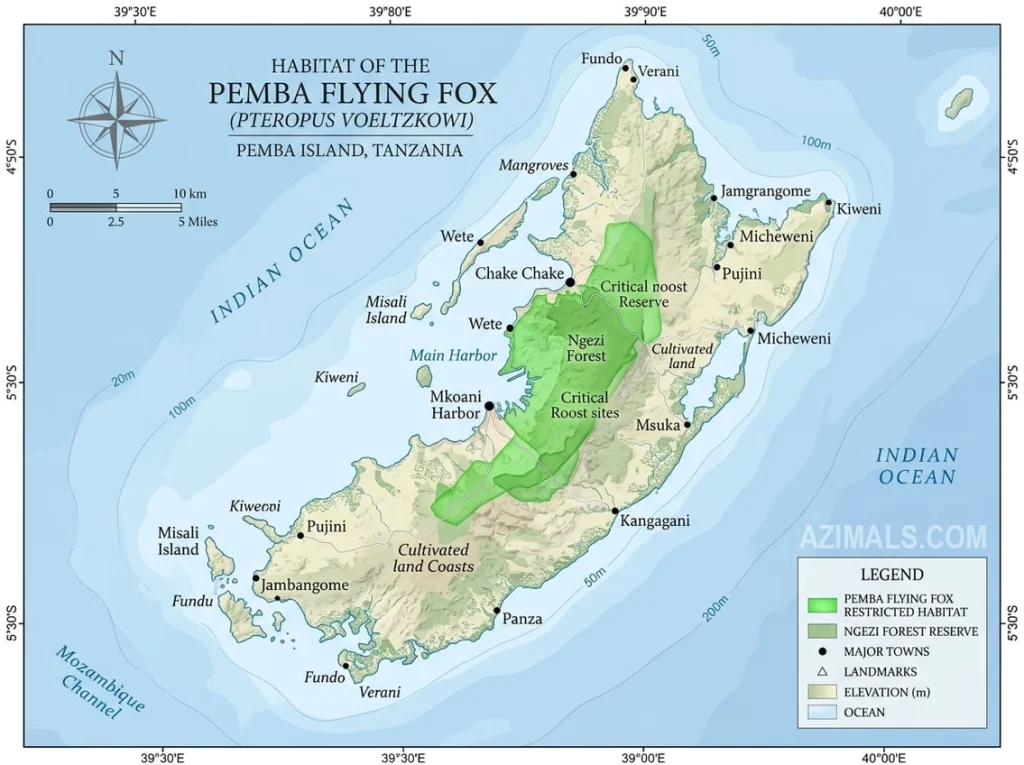
The Pemba flying fox has a highly restricted geographic range. It is endemic solely to Pemba Island, a small, lush island in the Zanzibar Archipelago located about 30 miles off the coast of Tanzania.
Because they do not live in caves, these bats require large, mature trees for their daytime roosts. They gather in massive, noisy colonies (often called “camps”) consisting of hundreds or even thousands of individuals. They prefer to roost in primary forests, mangrove swamps, and traditional graveyard sites, where local customs have historically left the large trees undisturbed.
What Does the Pemba Flying Fox Eat?
The Pemba flying fox is a strict frugivore (fruit-eater).
As dusk falls, the colonies leave their roosts to forage across the island. Their diet consists almost entirely of native and cultivated fruits, including figs, mangoes, breadfruit, and papayas. They also consume pollen and nectar from flowering trees.
When eating, the bat crushes the fruit against the roof of its mouth to extract the sweet juice, spitting out the fibrous pulp and larger seeds. Smaller seeds are swallowed and dispersed later in their droppings, which acts as a highly effective natural fertilizer for the island.
Pemba Flying Fox vs. Standard Bats (Microbats)
How does a megabat like the Pemba flying fox differ from a standard microbat?
- Size: The Pemba flying fox has a 5-foot wingspan, whereas common microbats (like the Little Brown Bat) have wingspans of just 8 to 11 inches.
- Diet: Flying foxes eat fruit and nectar. Most microbats are insectivores that eat mosquitoes and moths.
- Navigation: Flying foxes use large, forward-facing eyes and a strong sense of smell to find fruit. Microbats use high-frequency echolocation to hunt insects in total darkness.
- Roosting: Flying foxes roost openly in the branches of large trees. Microbats typically roost in dark, enclosed spaces like caves, attics, or hollow logs.
Why Is It Endangered? (The Comeback Story)
In the late 1980s and early 1990s, the Pemba flying fox was critically endangered, with the population plummeting to fewer than a few hundred individuals.
- The Initial Threat: The bats were aggressively hunted with shotguns for bushmeat (considered a local delicacy). At the same time, their roosting trees were being clear-cut for agriculture and timber.
- The Turnaround: In the 1990s, the government of Zanzibar and international conservation groups launched an aggressive community education campaign. They helped locals realize that without the bats, the island’s fruit trees would not be pollinated or seeded. Unlike the Hirola Antelope, which continues to decline, the Pemba Flying Fox continues to increase.
- Current Status: Today, local communities actively protect the roosts, and hunting has largely stopped. The population has exploded to an estimated 20,000 to 30,000 individuals. While still classified as Vulnerable due to its restricted single-island range, it is considered one of Africa’s greatest conservation victories.
Frequently Asked Questions
The Pemba flying fox is one of the largest bat species in the world. It boasts a wingspan of up to 1.6 meters (about 5 feet 3 inches), though its body is relatively lightweight, weighing between 400 and 650 grams.
No. The Pemba flying fox is a frugivore, meaning it only eats fruit, nectar, and pollen. Vampire bats, which do consume blood, are small microbats found only in Central and South America.
No, Pemba flying foxes do not use echolocation. Because they hunt for stationary fruit rather than fast-moving insects, they rely entirely on their large eyes and excellent sense of smell to navigate and find food at night.
This bat is endemic to a single location on Earth: Pemba Island, which is part of the Zanzibar Archipelago off the eastern coast of Tanzania in Africa. It roosts in large trees in the island’s forests and mangroves.