
The kit fox (Vulpes macrotis) is the smallest species of wild dog found in North America. Instantly recognizable by their exceptionally large ears and slender, delicate frames, these nocturnal hunters are perfectly adapted to survive in some of the harshest desert environments on the continent. Despite their fragile appearance, they are highly efficient predators and play a crucial role in regulating desert rodent populations.
Quick Facts: Kit Fox Profile
| Category | Information |
|---|---|
| Scientific Name | Vulpes macrotis |
| Common Name | Kit fox, desert fox |
| Kingdom / Phylum | Animalia / Chordata |
| Class / Order | Mammalia / Carnivora |
| Family / Genus | Canidae / Vulpes |
| Diet Type | Omnivore (primarily carnivorous) |
| Average Lifespan | 7 to 10 years (in the wild) |
| Conservation Status | Least Concern (Some subspecies are Endangered) |
Physical Characteristics and Size
The kit fox is built specifically for heat dissipation and desert camouflage.
- Size & Length: They are remarkably small. The total body length ranges from 18 to 21 inches (45 to 53 cm), with a bushy tail adding another 10 to 13 inches.
- Weight: Adults weigh only 3.5 to 6 pounds (1.6 to 2.7 kg), making them roughly the size of a small house cat. Males are slightly larger than females.
- Ears: Their most defining feature is their massive ears, which can be up to 3.7 inches long. These ears serve a dual purpose: providing exceptional hearing to detect underground prey, and radiating body heat to keep the fox cool in the desert sun.
- Coat & Coloration: Their fur is a sandy, yellowish-gray color that blends perfectly into the desert landscape. The tips of their tails are distinctly black, and they feature dense hair on the soles of their feet to protect them from scorching desert sand and provide traction on loose dunes.
Geographic Range and Habitat
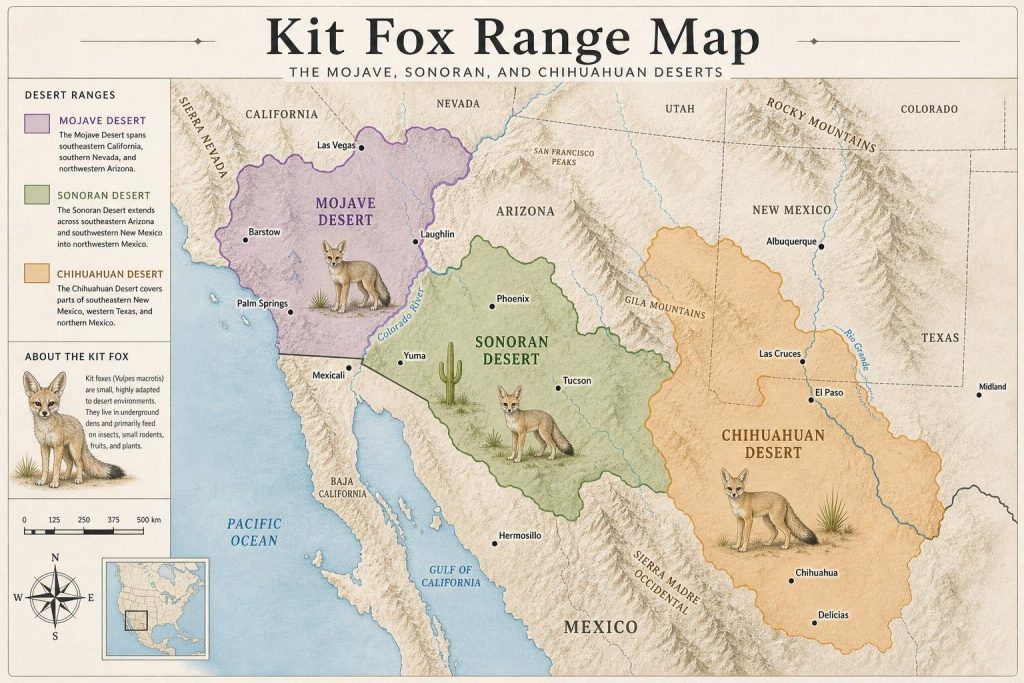
Kit foxes are native exclusively to the arid and semi-arid regions of North America. Their range covers the Southwestern United States (including California, Nevada, Utah, Arizona, New Mexico, and Texas) and extends down into northern and central Mexico.
Preferred Habitats: They avoid rugged, rocky, or mountainous terrain, strictly preferring:
- Desert scrublands and chaparral
- Arid short-grass prairies
- Loose, sandy soils and dunes
Because they need to escape the extreme daytime heat, kit foxes rely heavily on underground dens. They rarely dig their own from scratch; instead, they take over and expand abandoned badger, prairie dog, or kangaroo rat burrows, often maintaining multiple dens across their territory.
Diet and Hunting Behavior
The kit fox is a nocturnal hunter, emerging from its den only after the sun goes down and the desert cools off. While technically omnivores, their diet is heavily carnivorous.
What they eat:
- Primary Diet: Kangaroo rats, pocket mice, prairie dogs, and jackrabbits.
- Secondary Diet: Ground-dwelling birds, insects, lizards, and snakes.
- Plant Matter: They will occasionally eat desert tomatoes, cactus fruits, and scavenged human crops when prey is scarce.
Water Conservation: One of the most remarkable kit fox facts is that they rarely, if ever, need to drink standing water. Their bodies are highly adapted to extract all the moisture they need to survive directly from the blood and tissues of the prey they eat.
Reproduction and Life Cycle
Kit foxes are generally monogamous, forming pairs that mate for life, though they often forage and hunt independently.
Mating occurs between December and February. After a gestation period of roughly 50 days, the female gives birth to a litter of 1 to 7 pups (usually 4) in the safety of the underground den. The male provisions the female with food while she nurses.
The pups emerge from the den at around 4 weeks old, are fully weaned by 8 weeks, and begin hunting with their parents shortly after. By October, the young foxes disperse to claim their own territories.
Frequently Asked Questions (FAQ)
A kit fox primarily eats small desert rodents like kangaroo rats, pocket mice, and prairie dogs, as well as jackrabbits. They will also opportunistically eat insects, lizards, ground-dwelling birds, and occasionally desert fruits like cactus figs.
The kit fox habitat is restricted to the arid deserts and scrublands of the Southwestern United States and Northern Mexico. They prefer flat, sandy areas like the Mojave, Sonoran, and Chihuahuan deserts where they can easily modify underground burrows to escape the daytime heat.
The kit fox is the smallest wild dog in North America. They weigh only 3.5 to 6 pounds (about the size of a small domestic cat) and measure 18 to 21 inches in body length, plus a 10 to 13-inch bushy tail.
One of the most fascinating kit fox facts is that they almost never need to drink water; they get all the hydration they need from the bodies of their prey. Additionally, their massive ears act like radiators, releasing body heat to keep them cool in the desert environment.